Tuesday, April 19, 2011

Wealth of Nations

Wealth of Nations, Seed Magazine, 11/29/10

This article describes some fundamental changes in the ways we look at and measure wealth. It could lead eventually into an economic revolution globally. Here are a few excerpts:

"Amid the dark clouds of the 2008 financial crisis, as the media documented a litany of bank failures, collapsed credit markets, and growing panic well beyond Wall Street, there was a brighter headline: For the first time since scientists began tracking them, carbon emissions in the United States decreased. The drop was marginal, but this environmental success, when juxtaposed with the crippled economy, raised a troubling point: Two important objectives—mitigating climate change and reviving the economy—were at cross-purposes. And it now appears likely that this contradictory relationship extends far beyond atmospheric carbon and climate change. In area after area, issue after issue, economic growth appears to be whittling away at the very foundations of the global economy: the ecosystems that supply our food, fuel, clean water, and stable climate. Our principle measure of success, the gross domestic product, or GDP, excludes the worth and loss of ecosystems and the services they provide, because as valuable as they are, they have no price."

***

"The global public good that both epitomizes and encompasses the challenges that the world faces today is biological diversity, the variety of life on Earth. “Biodiversity loss is, in a sense, the big problem of which all others are relatively small applications,” says Charles Perrings, an environmental economist at Arizona State University and a fellow of the Beijer Institute in Stockholm. Biodiversity is the foundation of ecosystems that capture carbon and energy, and that cycle water and nutrients through the biosphere. These processes, in turn, enable all of the activities—from plant photosynthesis to potato farming—that make human life on Earth possible. Another way of looking at it, says Perrings, is that most human activity boils down to changing the mix of organisms with which we interact. Public health, for instance, is the control of which pathogens come into contact with humans. Farming is simply the tweaking of wild species to suit human tastes and energy needs. Science, medicine, and global agriculture rely heavily on the barely explored cornucopia of the world’s genetic resources. The loss of biodiversity, then, is the loss of everything.

To begin putting a price on such global public goods, says Perrings, we must understand that biodiversity has a dual nature. A healthy forest, for example, provides an array of public services, such as carbon sequestration and water filtration. The components of forestland, however—the trees, animals, and soil—are often privately owned. According to Perrings, this creates large externalities: Private actions, such as cutting down trees, have an effect on public well-being that isn’t reflected in the price of that timber. Clean water that benefits the region, medicinal plants that could benefit the nation, and carbon sequestration that is valuable to the entire world are all at risk of destruction because they are invisible to the market."

***

"Ecologies, we’re now beginning to understand, are best described as complex adaptive systems, with biodiversity as the key to their ability to absorb shocks and stresses. And the economic value of such resilience is likely to be extremely high. Experts have surmised, for example, that mass erosion of Louisiana’s coastal wetlands was largely to blame for the billions of dollars in damage from Hurricane Katrina. Some scientists now say that the worldwide push toward monoculture and away from crop diversity could create huge vulnerabilities in the global food supply."

***

"So today’s more sophisticated assessments don’t just attempt to quantify the benefits that ecosystems provide to humans; they also figure in the costs of foregone economic development and the expenses of conservation. A major 2002 review of 300 case studies published in the Proceedings of the National Academy of Sciences found that by investing $45 billion per year in a global reserve program, we could protect natural services worth some $5 trillion—a benefit-cost ratio of 100:1. In other words, even when the steep costs of non-development are figured into the equation, nature’s services emerge as the ultimate bargain.

It is increasingly evident that safeguarding ecosystems makes solid financial sense, yet biodiversity and the services that ecosystems provide have long been overlooked by classical economists. That is all about to change."

***

"Using more holistic metrics, we may unearth some telling truths. The US is an unrivaled powerhouse when it comes to per capita GDP: $47,500 per person as of 2008. Take into account life expectancy, “life satisfaction,” and ecological footprint, however, and suddenly the top ranking goes to Costa Rica, a nation with a per capita GDP of just $11,600. The global public value of Costa Rica’s forests, coupled with its robust PES* program to keep those forestlands healthy, is a major contributor to its top-notch ranking. In short, biodiversity and ecosystems can become a large slice of a poor nation’s development pie."

* Payments for Ecosystems Services

***

"Valuing ecosystems will strike some as a heartless utilitarian approach, tantamount to slapping dollar signs on species, soils, oceans, and air. What it presages, however, will be a change in the very shape of the global economic system: by valuing our landscapes and the services they impart, by recalibrating incentives toward their preservation, and by respecting the needs of communities most closely dependent on them. We will not just value what nature provides, but also reorganize around a new definition of what is valuable. "

Read More

On Early Warning Signs

On Early Warning Signs, George Sugihara, Seed Magazine, 12/20/10

Complex systems do not act like simple or even complicate systems.

"They can appear stationary for a long while, then without anything changing, they exhibit jumps in variability—so-called “heteroscedasticity.” For example, if one looks at the range of economic variables over the past decade (daily market movements, GDP changes, etc.), one might guess that variability and the universe of possibilities are very modest. This was the modus operandi of normal risk management. As a consequence, the likelihood of some of the large moves we saw in 2008, which happened over so many consecutive days, should have been less than once in the age of the universe.

Our problem is that the scientific desire to simplify has taken over, something that Einstein warned against when he paraphrased Occam: “Everything should be made as simple as possible, but not simpler.” Thinking of natural and economic systems as essentially stable and decomposable into parts is a good initial hypothesis, current observations and measurements do not support that hypothesis—hence our continual surprise. Just as we like the idea of constancy, we are stubborn to change. The 19th century American humorist Josh Billings, perhaps, put it best: “It ain’t what we don’t know that gives us trouble, it’s what we know that just ain’t so.”

So how do we proceed? There are a number of ways to approach this tactically, including new data-intensive techniques that model each system uniquely but look for common characteristics. However, a more strategic approach is to study these systems at their most generic level, to identify universal principles that are independent of the specific details that distinguish each system. This is the domain of complexity theory.

Among these principles is the idea that there might be universal early warning signs for critical transitions, diagnostic signals that appear near unstable tipping points of rapid change. The recent argument for early warning signs is based on the following: 1) that both simple and more realistic, complex nonlinear models show these behaviors, and 2) that there is a growing weight of empirical evidence for these common precursors in varied systems.

A key phenomenon known for decades is so-called “critical slowing” as a threshold approaches. That is, a system’s dynamic response to external perturbations becomes more sluggish near tipping points. Mathematically, this property gives rise to increased inertia in the ups and downs of things like temperature or population numbers—we call this inertia “autocorrelation”—which in turn can result in larger swings, or more volatility. In some cases, it can even produce “flickering,” or rapid alternation from one stable state to another (picture a lake ricocheting back and forth between being clear and oxygenated versus algae-ridden and oxygen-starved). Another related early signaling behavior is an increase in “spatial resonance”: Pulses occurring in neighboring parts of the web become synchronized. Nearby brain cells fire in unison minutes to hours prior to an epileptic seizure, for example, and global financial markets pulse together. The autocorrelation that comes from critical slowing has been shown to be a particularly good indicator of certain geologic climate-change events, such as the greenhouse-icehouse transition that occurred 34 million years ago; the inertial effect of climate-system slowing built up gradually over millions of years, suddenly ending in a rapid shift that turned a fully lush, green planet into one with polar regions blanketed in ice."

I'm not sure about our ability to find early warning signs in complex systems. Right now to me these attempts remind me of people trying to find ways around the second law of thermodynamics. People were always inventing perpetual motion machines only to have scientists eventually point out the flaw in the machine. Many people refused to believe that nature was so perverse as to not be completely reversible. (See note at end.)

I'm not sure that it's reached the state of a law of complex systems but it sure looks like one: that the future state of a complex system cannot be be predicted. That destroys everything that we thought we knew about logical determinism.

Complexity theory is rooted in Chaos theory, which in turn has its origins more than a century ago in the work of the French mathematician Henri Poincaré. Chaos is sometimes viewed as extremely complicated information, rather than as an absence of order. The point is that chaos remains deterministic. With perfect knowledge of the initial conditions and of the context of an action, the course of this action can be predicted in chaos theory. As argued by Ilya Prigogine, complexity is non-deterministic, and gives no way whatsoever to precisely predict the future. However, even chaotic systems are in real life unpredictable because there is no way to have perfect knowledge of the state of the chaotic system.

Read More.

Note: The second law of thermodynamics is an expression of the tendency that over time, differences in temperature, pressure, and chemical potential equilibrate in an isolated physical system. From the state of thermodynamic equilibrium, the law deduced the principle of the increase of entropy and explains the phenomenon of irreversibility in nature. The second law declares the impossibility of machines that generate usable energy from the abundant internal energy of nature by processes called perpetual motion of the second kind.

On Systemic Risk

On Systemic Risk, Ian Goldin, Seed Magazine, 12/16/10

"Systemic risk, as the world has learned the hard way, may arise as a result of the operation of market forces and is transmitted across geopolitical boundaries. As a consequence, it demands regulatory intervention as well as cooperation between countries. A new paradigm for dealing with systemic risk is needed.

Looming systemic risks include pandemics, which may spread more rapidly across a densely connected world, and bio-terrorism risks, which are likely to become increasingly systemic in the 21st century. The ability to produce biological and other weapons of mass destruction is becoming more widespread, especially among non-state actors, due to technological innovation (not least with the development of DNA synthesizers). Increases in population density, urbanization, and the growth of connectivity, both physically and virtually, means that dangerous recipes and panic can be instantaneously transmitted globally. And climate change, a silent tsunami that crept up on us, presents major systemic environmental, social, and economic risks to humanity."

Read More

On Resilience

On Resilience, Carl Folke, Seed Magazine, 2/9/11

"Loosely defined, resilience is the capacity of a system—be it an individual, a forest, a city, or an Linkeconomy—to deal with change and continue to develop. It is both about withstanding shocks and disturbances (like climate change or financial crisis) and using such events to catalyze renewal, novelty, and innovation. In human systems, resilience thinking emphasizes learning and social diversity. And at the level of the biosphere, it focuses on the interdependence of people and nature, the dynamic interplay of slow and gradual change. Resilience, above all, is about turning crisis into opportunity.

Resilience theory, first introduced by Canadian ecologist C.S. “Buzz” Holling in 1973, begins with two radical premises. The first is that humans and nature are strongly coupled and coevolving, and should therefore be conceived of as one “social-ecological” system. The second is that the long-held, implicit assumption that systems respond to change in a linear—and therefore predictable—fashion is altogether wrong. In resilience thinking, systems are understood to be in constant flux, highly unpredictable, and self-organizing with feedbacks across multiple scales in time and space. In the jargon of theorists, they are complex adaptive systems, exhibiting the hallmark features of complexity.

A key feature of complex adaptive systems is their ability to self-organize along a number of different pathways with possible sudden shifts between states: A lake, for example, can exist in either an oxygenated, clear state or an algae-dominated, murky one. A financial market can float on a housing bubble or settle into a basin of recession. Conventionally, we’ve tended to view the transition between such states as gradual. But there is increasing evidence that systems often don’t respond to change in a smooth way: The clear lake seems hardly affected by fertilizer runoff until a critical threshold is passed, at which point the water abruptly goes turbid. Resilience science focuses on these sorts of regime shifts and tipping points. It looks at incremental stresses, such as accumulation of greenhouse gases in combination with chance events—things like storms, fires, even stock market crashes—that can tip a system into another equilibrium state from which it is difficult, if not impossible, to recover. How far can a system be perturbed before this shift happens? How much shock can a system absorb before it transforms into something fundamentally different? How can active transformations from an undesirable social-ecological state into a better one be orchestrated? That, in a nutshell, is the essence of the resilience challenge.

The resilience line of thinking helps us avoid the trap of simply rebuilding and repairing flawed structures of the past—be it an economic system overly reliant on risky speculation or a health-care system that splits a nation at its financial seams and yet fails to deliver adequate coverage. Resilience encourages us to anticipate, adapt, learn, and transform human actions in light of the unprecedented challenges of our turbulent world."

Resilience in design is how to handle complex systems that run normally in non-equilibrium states. It is not a solution for all types of complex systems.

In my opinion, resilient design is how to deal with complex systems in non-equilibrium only. To cope with co-evolving systems you have to join in the co-evolution.

Read More

Sunday, April 17, 2011

Knowing Sooner

Knowing Sooner, Seed Magazine, 12/6/10

"By definition, complex systems—be they financial markets or weather patterns—contain too many moving parts to be reduced to any simple mathematical formula. It’s not just that we haven’t discovered an equation to express the behavior of the stock market; it’s that such an equation does not exist. Instead, researchers like Sornette construct and run computer models in order to gain insight into the potential behavior of these systems.

In developing these models, they have discovered that systems all share some surprisingly simple underlying properties. For instance, systems have the potential to change drastically in very short periods of time and often exhibit early warning signs that indicate when and how these changes will occur. These changes could be stock market crashes, tsunamis, heart attacks, or colony collapses, and in general are known as critical points. The theoretical properties of critical points have some profound—and often alarming—implications for real-world complex systems. In the case of climate change, when a critical level of greenhouse gas emissions is reached, it has been suggested that Earth’s climate may undergo rapid and irreversible changes. Identifying points like this one, and devising smart solutions to avoid the catastrophes they may bring, is critical.

To understand how phenomena like critical points come about in a system, consider a rock concert: A band has just finished its final encore, as a 60,000-plus crowd reacts in rapturous applause. The clapping begins as a cacophonous patter, eventually growing to a loud, chaotic roar. And then something interesting happens. Amid the noise, seemingly without effort or conscious guiding by the audience members, the applause evolves into a synchronized, steady rhythm; the claps become a single beat, with thousands of fans clapping in unison. Finally, it slows to a once again out-of-sync denouement, before abruptly ceasing altogether. The synchronized clapping emerges spontaneously in the crowd and is analogous to what is called a self-organizing property of a complex system, of which critical points are one example.

Sornette borrows this metaphor, originally articulated by Phillip Ball, to explain stock-market behavior. “A financial crash is not chaos. It’s when everyone agrees; it’s when everyone is clapping together,” he says. “So you have a synchronization of actions in the same way that clapping becomes synced.” The bubble in the Chinese stock market burst at just such a critical point. This is what Sornette claims to have predicted with his market model. According to him, what indicated that the financial bubble was going to burst was that the behavior of investors began oscillating, more and more wildly, between widespread buying and selling."

This is an interesting article but I'm not sure that I can believe it. Is it possible to know a future state of a complex system?

In general the answer is no. If you have the history of the the system you can look backwards and see how it got here, but you can't look forward. Even if you're observing the same system later and see the same pattern, you can't be sure that in the next instant the system will repeat what it did in the past.

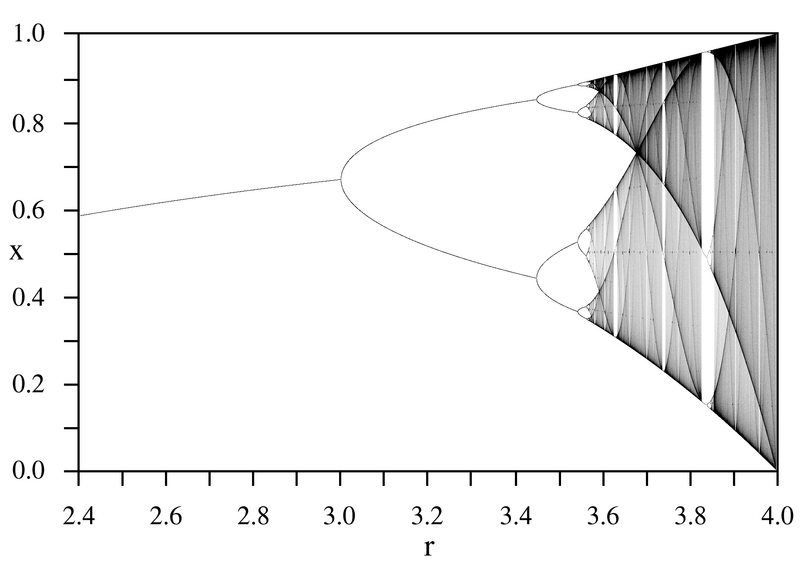
If the system is as simple as the logistic map, the large pattern of behavior can be "predicted" but only if the initial conditions are exactly the same, a condition not possible in the real world.


For an r between about 3.57 and 4, its behavior is chaotic. if you had a system like this one, you might be able to tell when you were approaching that region of chaos.

The mention of heart rhythm is troubling as well. A healthy heart has a chaotic rhythm. An unhealthy heart has a less chaotic rhythm. Breathing has similar characteristics. See secrets of the heart. Mechanical breathing systems work better when chaos is introduced.

I'm just afraid that we keep trying to find simple solutions to complex problems.

On Closing the Culture Gap

Paul Ehrlich, Seed Magazine, 2/9/11, 2/9/11

"Many are aware that climate disruption may cause horrendous problems, but few seem to realize that this peril is not the only potentially catastrophic one and may not even be the most serious threat we face. Humanity finds itself in a desperate situation, but you’d never know it from listening to the media and the politicians. Loss of the biodiversity that runs human life-support systems, toxification of the planet, the risk of pandemics that increase in lockstep with population growth, and the possibility of nuclear resource wars all could be more lethal. We are finally, however, starting to understand the patterns of culture change and the role of natural selection in shaping them. And since everything from weapons of mass destruction to global heating is the result of changes in human culture over time, acquiring a fundamental understanding of cultural evolution just might be the key to saving civilization from itself."

"That’s why a group of natural scientists, social scientists, and scholars from the humanities decided to inaugurate a Millennium Assessment of Human Behavior (MAHB, pronounced “mob”). It was so named to emphasize that it is human behavior, toward one another and toward the ecosystems that sustain us all, that requires both better understanding and rapid modification. The idea is that the MAHB might become a basic mechanism to expose society to the full range of population-environment-resource-ethics-power issues, and sponsor research on how to turn that knowledge into the required actions. Perhaps most important, the MAHB would stimulate a broad global discussion involving the greatest possible diversity of people, about what people desire, the ethics of those desires, and which are possible to meet in a sustainable society. It would, I hope, serve as a major tool for altering the course of cultural evolution."

More

The Top 20 (Plus 5) Technologies for the World Ahead

For those of you following my writing you know that I am very interested in complexity. It was nice to see in this article, published in The Futurist,May - June 2011 written by James Irvin and Sandra Schwarzback, highlighting complexity as a technology and listing it as number 19:

"19 Chaos Theories and Complexity Models

Our world is much more complex, interconnected, and dynamic than we once thought. New mathematical concepts are challenging the rationalized, deterministic, scientific models of the Industrial Age. The Industrial Age paradigm held that there is one best way to organize a given thing and that in all cases, a given “rational” outcome is predetermined by nature. The new scientific paradigm will ultimately replace this older mentality. The new Information Age is being driven by applied technology and by two major advances in theoretical science that are altering our view of how the world works: an ecological/ ecosystem model, which supports ecological and environmental diversity, and modern chaos and complexity theories, which emphasize unpredictability, self-organizing systems, and the coexistence of the linear and the random. In the near term, this paradigm shift will significantly change people's views of society, of themselves in relation to society, and of how the world and the greater universe work."

This is a pretty good summary of the importance of the subject (although they get the terminology twisted up).

There were two other things in this article that caught my attention. The first is the way that they describe graphically paradigm revolution as shown below:

I've been drawing this s-curve type of progress this was since the early 1990s and I haven't seen it shown this way at all. I'm speaking about the step down from an old to a new paradigm.

I'm not at all sure about their description of the future as the Robotic - Biotech Age. I would look for a name closer to the technology of the means production that is coming and I think that that has to be nano technology. My second choice would be something in the energy field, but I don't see any thing right now that would revolutionize energy.

Their chart is interesting never-the-less: