
This book is subtitled “Why Simple Things Become Complex (and How Complex Things Can Be Made Simple.”
To me the use of the word complexity in the title and most of book is misleading. Most of the time the author is writing about what I would call complicated systems. Complicated systems do not have the distinctive characteristics of complex systems such as emergence or randomness. Furthermore, a complex system cannot be made simple. Humans are quite often fooled by complexity and make assumptions that result in simple solutions, often with disastrous consequences. However, dealing with complicated systems is still daunting. And, I really liked his many examples and his analysis that many of the complicated systems we deal with are results of our own design.
However, the book is still an interesting read, and he does offer some insights into how to change complicated systems into simpler ones.
One of the sticky points for me in using better design to make products less complicated is that would require much more complete knowledge of what customers want. And, as most markets are complex, achieving that degree of certainty will be impossible. A real conundrum.
Simplexity, Jeffrey Kluger, Hyperion, 2008, 150p
Thursday, September 24, 2009


The Tao of Chaos
“Tao is a concept found in Taoism, Confucianism, and more generally in ancient Chinese philosophy. While the character itself translates as 'way', 'path', or 'route', or sometimes more loosely as 'doctrine' or 'principle', it is used philosophically to signify the fundamental or true nature of the world. The concept of Tao differs from Western ontology, however; it is an active and holistic conception of the world, rather than a static, atomistic one.” - Wikipedia
Katya Walter has written an interesting and insightful book linking the concepts of chaos to the double helix of genetics to the I Ching of ancient Chinese culture. Along the way she provides some of the best explanations of chaos and fractals I've read.
She begins her journey with a section called Beyond Linear Limits that I'm going to quote from extensively:
“Late one Saturday afternoon in Austin, Texas, I faced a showdown between my left and right brains. Shoot-out time. It was June 8, 1985, and it happened at the East-West Center when Diana Latham urged me to try the I Ching, just once. So reluctantly, I did ... with a lackadaisical and dubious query. But the response bowled me over! It was devastatingly appropriate-and poetic. Sheer chance, of course.
But when I tried it again later out of curiosity, it worked again. Moreover, the old Chinese oracle's answer again touched some deep chord in me that logic alone didn't reach. A response to wisdom, a welcoming hosanna of "Yes, that's it!"
I was confronted with the notion that this absurd old oracle might actually work, odd as that seemed to my logical mind. Irrational. So strange in fact that I ignored it for awhile. I could not admit the possibility ... so it chewed just underneath. After all, I was modern savvy, educated past superstition. A Ph.D. teaching at the University of Texas. Wasn't I? Logic shot the I Ching..down. Didn't it?
But I couldn't quite dismiss it. How in heaven's name could that abstract and ancient oracle mesh in such an amazing way with the events in my own modernday life? Rationality said, "Impossible Chance! Gullibility!"
But the simple fact remained: it had told me apt wisdom, pointed and calm, like a grandparent whispering in my ear. So I decided to explore in rational terms if such a thing might possibly be.”
Later in that section, she goes on to explain the I Ching:
“But I have slowly learned that the I Ching reveals the pattern. Not the specifics of an event, but its underlying pattern. It works through the dynamics of chaos theory, which can predict a trend without specifying its exact details. Discovering this huge hidden intelligence that rests deep in the weave of nature, even learning to communicate with it, can be disconcerting, frightening .. , until it becomes wonderful.
The discovery reveals a deeper truth beyond the limits of what we call normal reality. It exhibits an underlying coherent pattern in the dynamic chaos of nature itself. More eerily, it exhibits a tappable caring that's nestled in the very fabric of spacetine-mattergy, This huge pattern knits the Cosmos together in physics and metaphysics. It unites the objective and the subjective, the quantitative and qualitative, the alpha and omega. Its vast dynamic shapes us, body and soul.
But even now, despite extensive experience, I still understand why people fear such a possibility lurking beyond the sensory reality. What is this strange domain of power? It sounds rather like superstitious enslavement to some bogey of the imagination…and that is worthy of fear.
Fear is a reasonable response, It sees the psychic loss in giving oneself up to superstition and voodoo rites, in relinquishing personal power to brutal gods with canny, greedy priests, to wizards, healers, or gurus only too willing to manipulate their followers if given a chance, It fears an abandonment into destructive and orgiastic fantasy, a letting-go of choices, a precipitous lapsing away from logic to become lost in the enchantment of the deep. The descent looks too dangerous into the primal power of raw archetypes. It seems the epitome of romantic release to Dionysius, where one fears and yet follows a blind pull into the passionate unknown.
In here is an emotional powerhouse. In here, people "lose control" and argue or rape or fall blindly in love or seek the grail. They kill others in holy war or devote the rest of a short lifetime to the cure of AIDS or become inspired to paint a masterpiece. Moments or years later, a person can say bemusedly, "I don't know what came over me," or "Something possessed me," or "I felt driven!" or "The devil made me do it," or "I followed my bliss and it has blessed me."
This mysterious domain is not logical. It has it own reasons that reason does not know. To quote a bewildered Woody Allen, "The heart wants what it wants." But a passionate vision can so easily lead to bitter disillusion, to mob violence, to some idiosyncratic utopia where a demagogue-religious or social or political-holds sway and demands blind faith of spellbound followers who do battle for the cause. Some cause. It can idealize a saint or a demagogue to follow, fix upon some vile enemy to conquer, so that half of its huge polarized energy is projected away into the outer world to become wooed or defeated, driving us without free will.
Yet there is also fear of no passion. Cool Apollonian logic can survey this universe with a despairing sense that it is caught in some limitless, endless, mindless design that also leaves no room for free will. Sartre showed us the architecture of this existential prison with no exit from a godless hell of cold linear logic. It locks us into a gray, chilly, basement whose flat expanse of pointless concrete data cannot conceal the futile bones buried beneath. Here is dead-end living,
Both extremes - passionate romantic or cool logician - reveal a paucity of perspective in the West for more than 2,500 years. It has split us into romantic versus classic, liberal versus conservative, left versus right, heart versus head. But it is possible to encompass both poles within a larger, transcendental third stance. This paradigm is cradled in chaos theory, that amazing new science of the 20th century. It reveals the I Ching is a model of chaos patterning in microcosm. It even connects science to spirit.”
She tells of the loss of spiritual depth in our society to the rise of drugs. “ …habituating drugs can only offer a road away from, not to. The escape into addiction is triggered by our search for psychic release from the data-mad mire of ordinary life.”
Walters discusses the difficulty of comprehending the Tao.
“Laotse opens his Tao Te Ching this way: 'The Tao that can be spoken is not the Tao.'”
And, she summarizes her way through this enigma. “By discovering that the I Ching is merely a spiritual version of DNA, and both of them are merely subprograms of a deeper, even universal order called complementary chaos. For the scientific mind, this allows the security of an explanation. For the mystical soul, it opens an endless vista on wordless beauty charged with transcendent connection.”
In an article written by Katya Walter reprinted in Future Positive in 2004, she explained the concept of patterned chaos:
“My book Tao of Chaos discusses in detail the ability of both DNA and the I Ching to combine fractal analog and binary functions. It is based on modern chaos theory, which can predict a trend without specifying its exact details. Chaos patterning is determined because it can predict an overall pattern, but also chaotic because it cannot specify any exact point of its next manifestation. The mathematician can determine its general form but not the exact contents. Patterned chaos has its own special signature:
• Order in the midst of apparent disorder.
• Cycling that repeats with continual slight variation.
• Scaling that fits one level into another like nesting boxes
• Universal applicability. “
This an extremely import concept for it allows her to connect patterned chaos to fractal geometry.
Patterned chaos is also linking many disciplines together.
“The universal import of this odd new science is even tending to heal the ever-dividing rift of disciplines that fragmented the past centuries into splinter groups specializing ever more narrowly in describing more and more about less and less. But now cardiac specialists stockbrokers, psychologists, and turbulence physicists can all meet in joint conference on chaos patterning. A recent conference held in Florida sponsored papers on chaos patterns in physiology, biophysics, gestalt psychology, chemical systems, mathematics, physics, communication theory and linguistics. Such unity within diversity was unheard of not so long ago. Here indeed is interdisciplinary reunion. Patterned chaos can find shared meaning in areas as wide-ranging as plasma physics, genetic coding, perceptual psychology, coffee prices, weather reports, the body's living ductwork of blood vessels, airways, and nerve impulses.”
The author then spends several chapters relating patterned chaos to fractal geometry, which provides much needed insight into the application of the new geometry to the science of chaos.
One of the other powerful concepts in this book is the concept of complementary chaos (or co-chaos, sometimes cochaos).
xn+1 = rxn(1-xn),
where n is the iteration number and r is a constant. Repeated application of this equation produces the complicated graph below (Wikipedia)

You can observe the digital doubling effect by looking at the branches: 1, 2, 4 and 8. But, beyond that, the logistic map becomes “random”. At eight branches, called period 3, the state of the logistics map is very close to wild fluctuations.
Complementary chaos results from the counterpoise of two period 3 systems. Walters uses this model to draw analogies with the double helix genetic code and the I Ching.
I am not in any position to verify these assertions. But the theory offers a tantalizing hint of a unification of East and West, and the unification of several sciences in the Western tradition.
In any case, I'll close with the advice of Buddha:
"Chaos is inherent in all compounded things. Strive on with diligence." - Buddha
The Tao of Chaos
Katya Walter
Kairos Center, 1994, 287 p
You can find more information about Katya Walter and her work on her web site, The Double Bubble Universe
Katya Walter has written an interesting and insightful book linking the concepts of chaos to the double helix of genetics to the I Ching of ancient Chinese culture. Along the way she provides some of the best explanations of chaos and fractals I've read.
She begins her journey with a section called Beyond Linear Limits that I'm going to quote from extensively:
“Late one Saturday afternoon in Austin, Texas, I faced a showdown between my left and right brains. Shoot-out time. It was June 8, 1985, and it happened at the East-West Center when Diana Latham urged me to try the I Ching, just once. So reluctantly, I did ... with a lackadaisical and dubious query. But the response bowled me over! It was devastatingly appropriate-and poetic. Sheer chance, of course.
But when I tried it again later out of curiosity, it worked again. Moreover, the old Chinese oracle's answer again touched some deep chord in me that logic alone didn't reach. A response to wisdom, a welcoming hosanna of "Yes, that's it!"
I was confronted with the notion that this absurd old oracle might actually work, odd as that seemed to my logical mind. Irrational. So strange in fact that I ignored it for awhile. I could not admit the possibility ... so it chewed just underneath. After all, I was modern savvy, educated past superstition. A Ph.D. teaching at the University of Texas. Wasn't I? Logic shot the I Ching..down. Didn't it?
But I couldn't quite dismiss it. How in heaven's name could that abstract and ancient oracle mesh in such an amazing way with the events in my own modernday life? Rationality said, "Impossible Chance! Gullibility!"
But the simple fact remained: it had told me apt wisdom, pointed and calm, like a grandparent whispering in my ear. So I decided to explore in rational terms if such a thing might possibly be.”
Later in that section, she goes on to explain the I Ching:
“But I have slowly learned that the I Ching reveals the pattern. Not the specifics of an event, but its underlying pattern. It works through the dynamics of chaos theory, which can predict a trend without specifying its exact details. Discovering this huge hidden intelligence that rests deep in the weave of nature, even learning to communicate with it, can be disconcerting, frightening .. , until it becomes wonderful.
The discovery reveals a deeper truth beyond the limits of what we call normal reality. It exhibits an underlying coherent pattern in the dynamic chaos of nature itself. More eerily, it exhibits a tappable caring that's nestled in the very fabric of spacetine-mattergy, This huge pattern knits the Cosmos together in physics and metaphysics. It unites the objective and the subjective, the quantitative and qualitative, the alpha and omega. Its vast dynamic shapes us, body and soul.
But even now, despite extensive experience, I still understand why people fear such a possibility lurking beyond the sensory reality. What is this strange domain of power? It sounds rather like superstitious enslavement to some bogey of the imagination…and that is worthy of fear.
Fear is a reasonable response, It sees the psychic loss in giving oneself up to superstition and voodoo rites, in relinquishing personal power to brutal gods with canny, greedy priests, to wizards, healers, or gurus only too willing to manipulate their followers if given a chance, It fears an abandonment into destructive and orgiastic fantasy, a letting-go of choices, a precipitous lapsing away from logic to become lost in the enchantment of the deep. The descent looks too dangerous into the primal power of raw archetypes. It seems the epitome of romantic release to Dionysius, where one fears and yet follows a blind pull into the passionate unknown.
In here is an emotional powerhouse. In here, people "lose control" and argue or rape or fall blindly in love or seek the grail. They kill others in holy war or devote the rest of a short lifetime to the cure of AIDS or become inspired to paint a masterpiece. Moments or years later, a person can say bemusedly, "I don't know what came over me," or "Something possessed me," or "I felt driven!" or "The devil made me do it," or "I followed my bliss and it has blessed me."
This mysterious domain is not logical. It has it own reasons that reason does not know. To quote a bewildered Woody Allen, "The heart wants what it wants." But a passionate vision can so easily lead to bitter disillusion, to mob violence, to some idiosyncratic utopia where a demagogue-religious or social or political-holds sway and demands blind faith of spellbound followers who do battle for the cause. Some cause. It can idealize a saint or a demagogue to follow, fix upon some vile enemy to conquer, so that half of its huge polarized energy is projected away into the outer world to become wooed or defeated, driving us without free will.
Yet there is also fear of no passion. Cool Apollonian logic can survey this universe with a despairing sense that it is caught in some limitless, endless, mindless design that also leaves no room for free will. Sartre showed us the architecture of this existential prison with no exit from a godless hell of cold linear logic. It locks us into a gray, chilly, basement whose flat expanse of pointless concrete data cannot conceal the futile bones buried beneath. Here is dead-end living,
Both extremes - passionate romantic or cool logician - reveal a paucity of perspective in the West for more than 2,500 years. It has split us into romantic versus classic, liberal versus conservative, left versus right, heart versus head. But it is possible to encompass both poles within a larger, transcendental third stance. This paradigm is cradled in chaos theory, that amazing new science of the 20th century. It reveals the I Ching is a model of chaos patterning in microcosm. It even connects science to spirit.”
She tells of the loss of spiritual depth in our society to the rise of drugs. “ …habituating drugs can only offer a road away from, not to. The escape into addiction is triggered by our search for psychic release from the data-mad mire of ordinary life.”
Walters discusses the difficulty of comprehending the Tao.
“Laotse opens his Tao Te Ching this way: 'The Tao that can be spoken is not the Tao.'”
And, she summarizes her way through this enigma. “By discovering that the I Ching is merely a spiritual version of DNA, and both of them are merely subprograms of a deeper, even universal order called complementary chaos. For the scientific mind, this allows the security of an explanation. For the mystical soul, it opens an endless vista on wordless beauty charged with transcendent connection.”
In an article written by Katya Walter reprinted in Future Positive in 2004, she explained the concept of patterned chaos:
“My book Tao of Chaos discusses in detail the ability of both DNA and the I Ching to combine fractal analog and binary functions. It is based on modern chaos theory, which can predict a trend without specifying its exact details. Chaos patterning is determined because it can predict an overall pattern, but also chaotic because it cannot specify any exact point of its next manifestation. The mathematician can determine its general form but not the exact contents. Patterned chaos has its own special signature:
• Order in the midst of apparent disorder.
• Cycling that repeats with continual slight variation.
• Scaling that fits one level into another like nesting boxes
• Universal applicability. “
This an extremely import concept for it allows her to connect patterned chaos to fractal geometry.
Patterned chaos is also linking many disciplines together.
“The universal import of this odd new science is even tending to heal the ever-dividing rift of disciplines that fragmented the past centuries into splinter groups specializing ever more narrowly in describing more and more about less and less. But now cardiac specialists stockbrokers, psychologists, and turbulence physicists can all meet in joint conference on chaos patterning. A recent conference held in Florida sponsored papers on chaos patterns in physiology, biophysics, gestalt psychology, chemical systems, mathematics, physics, communication theory and linguistics. Such unity within diversity was unheard of not so long ago. Here indeed is interdisciplinary reunion. Patterned chaos can find shared meaning in areas as wide-ranging as plasma physics, genetic coding, perceptual psychology, coffee prices, weather reports, the body's living ductwork of blood vessels, airways, and nerve impulses.”
The author then spends several chapters relating patterned chaos to fractal geometry, which provides much needed insight into the application of the new geometry to the science of chaos.
One of the other powerful concepts in this book is the concept of complementary chaos (or co-chaos, sometimes cochaos).
We are all probably familiar with digital doubling: 20 = 1, 21 = 2, 22 = 4, 23 = 8, etc. Fewer people are probably less familiar with analog doubling in an example like the logistic map. The logistic map is the result of repeated application of the rather simple looking logistic function:
xn+1 = rxn(1-xn),
where n is the iteration number and r is a constant. Repeated application of this equation produces the complicated graph below (Wikipedia)


You can observe the digital doubling effect by looking at the branches: 1, 2, 4 and 8. But, beyond that, the logistic map becomes “random”. At eight branches, called period 3, the state of the logistics map is very close to wild fluctuations.
Complementary chaos results from the counterpoise of two period 3 systems. Walters uses this model to draw analogies with the double helix genetic code and the I Ching.
I am not in any position to verify these assertions. But the theory offers a tantalizing hint of a unification of East and West, and the unification of several sciences in the Western tradition.
In any case, I'll close with the advice of Buddha:
"Chaos is inherent in all compounded things. Strive on with diligence." - Buddha
The Tao of Chaos
Katya Walter
Kairos Center, 1994, 287 p
You can find more information about Katya Walter and her work on her web site, The Double Bubble Universe
Complexity: A Guided Tour
This is an excellent book to study if you are just beginning to read about complexity and are interested in the application of the science of complexity to artificial and real life. Melanie Mitchell is well qualified to teach us about this field as she has been connected with Santa Fe Institute since 1989, five years after it was founded. The book is well written, easy to read and follows impeccable logic.
The book begins with a quote from Douglas Hofstadter, Godel, Escher, Bach, “Reductionism is the most natural thing in the world to grasp. It's simply the belief that 'a whole can be understood completely if you understand its parts, and the nature of their sum.' No one her left brain could reject reductionism.” In complexity reductionism doesn't apply. You can't understand a complex system as a sum of its parts. It can only be understood as a gestalt.
“How is it that those systems in nature we call complex and adaptive-brains, insect colonies, the immune system, cells, the global economy, biological evolution-produce such complex and adaptive behavior from underlying, simple rules? How can interdependent yet self-interested organisms come together to cooperate on solving problems that affect their survival as a whole? And are there any general principles or laws that apply to such phenomena? Can life, intelligence, and adaptation be seen as mechanistic and computational? If so, could we build truly intelligent and living machines? And if we could, would we want to?
I have learned that as the lines between disciplines begin to blur, the content of scientific discourse also gets fuzzier. People in the field of complex systems talk about many vague and imprecise notions such as spontaneous order, self-organization, and emergence (as well as "complexity" itself).”
The author describes the following properties of complex adaptive systems:
“When looked at in detail, these various systems are quite different, but viewed at an abstract level they have some intriguing properties in common:
Complex collective behavior
Signaling and information processing: All these systems produce and use information and signals from both their internal and external environments.
Adaptation: All these systems adapt-that is, change their behavior to improve their chances of survival or success-through learning or evolutionary processes.”
She follows this with two versions of a definition of a complex system:
1. “A system in which large networks of components with no central control and simple rules of operation give rise to complex behavior, sophisticated information processing, and adaption via learning or evolution”
2. “A system that exhibits nontrivial emergent and self organizing behavior”
She adds the comment that some people apply these concepts only to adaptive complex systems, but that she does not. Which is unfortunate because her definition limits complexity essentially to living systems, leaving out many non adaptive complex systems generally accepted as examples of complexity. But, her book is limited to a train of thought that leads to artificial and real life, and she stays almost consistent with that view.
She also reports that there are no agreed measurements of complexity.
With this review of the development and state of complexity science in general, the author then launches into the logical development of the history and state of artificial life:
• Life and evolution in computers
• Computation writ large
• Network thinking
• The past and future of the sciences of complexity
“…how did life originate in the first place? And what exactly constitutes being alive? As you can imagine, both questions are highly contentious in the scientific world, and no one yet has definitive answers. Although I do not address the first question here, there has been some fascinating research on it in the complex systems community.
The second question-what is life, exactly?-has been on the minds of people probably for as long as "people" have existed. There is still no good agreement among either scientists or the general public on the definition of life. Questions such as "When does life begin?" or "What form could life take on other planets?" are still the subject of lively, and sometimes vitriolic, debate.
The idea of creating artificial life is also very old, going back at least two millennia to legends of the Golem and of Ovid's Pygmalion, continuing in the nineteenth-century story of Frankenstein's monster, all the way to the present era of movies such as Blade Runner and The Matrix, and computer games such as "Sim Life."
These works of fiction both presage and celebrate anew, technological version of the "What is life?" question: Is it possible for computers or robots to be considered "alive"? This question links the previously separate topics of computation and of life and evolution.”
This book is not an easy read, but it's worth the effort. The author has done an outstanding job of writing about the science of complexity in a way that facilitates understanding.
Complexity: A Guided Tour, Melanie Mitchell, Oxford University Press, 2009, 349 p
The book begins with a quote from Douglas Hofstadter, Godel, Escher, Bach, “Reductionism is the most natural thing in the world to grasp. It's simply the belief that 'a whole can be understood completely if you understand its parts, and the nature of their sum.' No one her left brain could reject reductionism.” In complexity reductionism doesn't apply. You can't understand a complex system as a sum of its parts. It can only be understood as a gestalt.
“How is it that those systems in nature we call complex and adaptive-brains, insect colonies, the immune system, cells, the global economy, biological evolution-produce such complex and adaptive behavior from underlying, simple rules? How can interdependent yet self-interested organisms come together to cooperate on solving problems that affect their survival as a whole? And are there any general principles or laws that apply to such phenomena? Can life, intelligence, and adaptation be seen as mechanistic and computational? If so, could we build truly intelligent and living machines? And if we could, would we want to?
I have learned that as the lines between disciplines begin to blur, the content of scientific discourse also gets fuzzier. People in the field of complex systems talk about many vague and imprecise notions such as spontaneous order, self-organization, and emergence (as well as "complexity" itself).”
The author describes the following properties of complex adaptive systems:
“When looked at in detail, these various systems are quite different, but viewed at an abstract level they have some intriguing properties in common:
Complex collective behavior
Signaling and information processing: All these systems produce and use information and signals from both their internal and external environments.
Adaptation: All these systems adapt-that is, change their behavior to improve their chances of survival or success-through learning or evolutionary processes.”
She follows this with two versions of a definition of a complex system:
1. “A system in which large networks of components with no central control and simple rules of operation give rise to complex behavior, sophisticated information processing, and adaption via learning or evolution”
2. “A system that exhibits nontrivial emergent and self organizing behavior”
She adds the comment that some people apply these concepts only to adaptive complex systems, but that she does not. Which is unfortunate because her definition limits complexity essentially to living systems, leaving out many non adaptive complex systems generally accepted as examples of complexity. But, her book is limited to a train of thought that leads to artificial and real life, and she stays almost consistent with that view.
She also reports that there are no agreed measurements of complexity.
With this review of the development and state of complexity science in general, the author then launches into the logical development of the history and state of artificial life:
• Life and evolution in computers
• Computation writ large
• Network thinking
• The past and future of the sciences of complexity
“…how did life originate in the first place? And what exactly constitutes being alive? As you can imagine, both questions are highly contentious in the scientific world, and no one yet has definitive answers. Although I do not address the first question here, there has been some fascinating research on it in the complex systems community.
The second question-what is life, exactly?-has been on the minds of people probably for as long as "people" have existed. There is still no good agreement among either scientists or the general public on the definition of life. Questions such as "When does life begin?" or "What form could life take on other planets?" are still the subject of lively, and sometimes vitriolic, debate.
The idea of creating artificial life is also very old, going back at least two millennia to legends of the Golem and of Ovid's Pygmalion, continuing in the nineteenth-century story of Frankenstein's monster, all the way to the present era of movies such as Blade Runner and The Matrix, and computer games such as "Sim Life."
These works of fiction both presage and celebrate anew, technological version of the "What is life?" question: Is it possible for computers or robots to be considered "alive"? This question links the previously separate topics of computation and of life and evolution.”
This book is not an easy read, but it's worth the effort. The author has done an outstanding job of writing about the science of complexity in a way that facilitates understanding.
Complexity: A Guided Tour, Melanie Mitchell, Oxford University Press, 2009, 349 p
Thursday, September 10, 2009
The Cost Conundrum in Health Care
Atul Gawande, New Yorker, writes in What a Texas town can teach us about health care:
"It is spring in McAllen, Texas. The morning sun is warm. The streets are lined with palm trees and pickup trucks. McAllen is in Hidalgo County, which has the lowest household income in the country, but it’s a border town, and a thriving foreign-trade zone has kept the unemployment rate below ten per cent. McAllen calls itself the Square Dance Capital of the World. “Lonesome Dove” was set around here.
McAllen has another distinction, too: it is one of the most expensive health-care markets in the country. Only Miami—which has much higher labor and living costs—spends more per person on health care. In 2006, Medicare spent fifteen thousand dollars per enrollee here, almost twice the national average. The income per capita is twelve thousand dollars. In other words, Medicare spends three thousand dollars more per person here than the average person earns.
The explosive trend in American medical costs seems to have occurred here in an especially intense form. Our country’s health care is by far the most expensive in the world. In Washington, the aim of health-care reform is not just to extend medical coverage to everybody but also to bring costs under control. Spending on doctors, hospitals, drugs, and the like now consumes more than one of every six dollars we earn. The financial burden has damaged the global competitiveness of American businesses and bankrupted millions of families, even those with insurance. It’s also devouring our government. “The greatest threat to America’s fiscal health is not Social Security,” President Barack Obama said in a March speech at the White House. “It’s not the investments that we’ve made to rescue our economy during this crisis. By a wide margin, the biggest threat to our nation’s balance sheet is the skyrocketing cost of health care. It’s not even close".”
More
This is an excellent article and worth reading in it's entirety. I think that the key point of the article is that the cost of health care, in aggregate, is not related to income, but in the business model used to deliver that health care. In McAllen, Texas, the author reports, “In 2006, Medicare spent fifteen thousand dollars per enrollee here, almost twice the national average. The income per capita is twelve thousand dollars. In other words, Medicare spends three thousand dollars more per person here than the average person earns.” On the other hand, “ Rochester, Minnesota, where the Mayo Clinic dominates the scene, has fantastically high levels of technological capability and quality, but its Medicare spending is in the lowest fifteen per cent of the country—$6,688 per enrollee in 2006, which is eight thousand dollars less than the figure for McAllen.”
The difference between these two examples is that in McAllen, the doctors, labs, hospitals, etc. are all run as businesses, and the Mayo Clinic is run as a service and the doctors collaborate and are paid salaries.
I've been a small voice against the rationalization of the business paradigm to shareholder economic value added and its adoption in other industries (such as health care and education, since 2003 (The Evils of EVA and the Myth of Shareholder Value and Its Relation...). Now we have discovered that can be disastrous even when applied in the financial industry. Healthcare should not be run as a business. Nor should government run it.
Outside of mainstream business, society is learning that openness, decentralization and collaboration are required to tackle large problems and some of these concepts are being applied successfully in business (Coase's Penguin, or Linux and the Nature of the Firm and Wikinomics). We haven't learned that yet in healthcare.
Furthermore, as reported in the Cost Conundrum, the amount of Medicare spending is inversely related to the quality of health care. “Two economists working at Dartmouth, Katherine Baicker and Amitabh Chandra, found that the more money Medicare spent per person in a given state the lower that state’s quality ranking tended to be. In fact, the four states with the highest levels of spending—Louisiana, Texas, California, and Florida—were near the bottom of the national rankings on the quality of patient care.”
In order to get a sense of the problem, let's look at a few statistics about healthcare in the US.
The United States Department of Labor, Bureau of Labor Statistics reports:
* As the largest industry in 2006, health care provided 14 million jobs—13.6 million jobs for wage and salary workers and about 438,000 jobs for the self-employed.
* 7 of the 20 fastest growing occupations are health care related.
* Health care will generate 3 million new wage and salary jobs between 2006 and 2016, more than any other industry.
* Most workers have jobs that require less than 4 years of college education, but health diagnosing and treating practitioners are among the most educated workers.
According to PreventDisease.com:
“Escalating health care costs continue to remain an issue of great concern for many employers and providers of health care services. Here are some of the latest statistics concerning health care:
* Preventable illness makes up approximately 80% of the burden of illness and 90% of all healthcare costs.
* Preventable illnesses account for eight of the nine leading categories of death.
* The United States spends more on health care than any other industrialized nation in the world and yet, in many respects, it's citizens are not the healthiest. (2)
* More than one-quarter of children without health insurance coverage had no usual source of health care in 1997, compared with 4 percent of children with health insurance. (4)
* Uninsured children were nearly three times as likely as those with health insurance to be without a recent doctor's visit in 1997. (4)
* The US healthcare system is the most expensive of systems, outstripping by over half again the health care expenditures of any other country. (2)
* In 1997, health care costs in the US totaled in excess of $1 trillion. (2)
* Health care costs in the United States exceed 14% of the gross domestic product. (2)
* The average cost of health care per person in the United States approximated $3,925 in 1997. (3)
* Lifetime medical costs average approximately $225,000 per person. (1)
* Some 18 percent of lifetime costs for medical care--over $40,000--is estimated to be incurred in the last year of life. (1)
* Despite expenditures in excess of $1 trillion, the number of people without health insurance continues to increase reaching 43.4 million--16.1% of our population--in 1997. (2)
* The Health Care Financing Administration's analysts recently projected that, beginning in 1998, national health spending would again begin to grow faster than the rest of the economy. (2)
* By 2002, the HCFA projected that national health expenditures would total $2.1 trillion--an estimated 16.6 percent of the gross domestic product. (2)”
In a study done 2008, the US lagged behind 18 other nations in halting preventable deaths, according to MedicineNet.com.
“The U.S. today finds itself last on a new list of countries seeking to curb preventable deaths in people younger than 75.
Not only does the U.S. have the worst spot on that list, its rate of improvement is also slower than the other 18 industrialized nations included in the study.”
“...the slow decline in U.S. preventable deaths 'has coincided with an increase in the uninsured population,'”
Some of the preventable diseases can be prevented by vaccines. WebMD reports, “Diseases easily preventable by adult vaccines kill more Americans each year than car wrecks, breast cancer, or AIDS.
Yet relatively few in the U.S. know much about these diseases -- and far too few adults get vaccinated, find surveys by the CDC and the National Foundation for Infectious Diseases (NFID).
'It may surprise you to learn that over 50,000 adults die each year of diseases that are potentially vaccine preventable,' NFID president-elect William Schaffner, MD, said at a news conference held to announce the survey results.”
Other preventable diseases include most cardiovascular problems and diabetes. Obesity is an epidemic.
Watch the short video.
The CDC reports:
“CDC addresses six critical types of adolescent health behavior that research shows contribute to the leading causes of death and disability among adults and youth. Other important issues that affect children and adolescents are also addressed:
1.Alcohol & Drug Use
Alcohol is used by more young people in the United States than tobacco or illicit drugs, and is a factor in approximately 41% of all deaths from motor vehicle crashes.
2.Injury & Violence (including suicide)
Injury and violence is the leading cause of death among youth aged 10-24 years: motor vehicle crashes (30% of all deaths), all other unintentional injuries (15%), homicide (15%), and suicide (12%).
3.Tobacco Use
Each day in the United States, approximately 4,000 adolescents aged 12-17 try their first cigarette. Each year cigarette smoking accounts for approximately 1 of every 5 deaths, or about 438,000 people. Cigarette smoking results in 5.5 million years of potential life lost in the United States annually.
4.Nutrition
Healthy eating is associated with reduced risk for many diseases, including the three leading causes of death: heart disease, cancer, and stroke. In 2007, only 21.4% of high school students reported eating fruits and vegetables five or more times daily (when fried potatoes and potato chips are excluded) during the past 7 days.
5.Physical Activity
Participation in physical activity declines as children get older. Overall, in 2007, 35% of 9-12 graders had participated in at least 60 minutes per day of physical activity.
6.Sexual Risk Behaviors
Each year, there are approximately 19 million new STD infections in the United States, and almost half of them are among youth aged 15 to 24. In 2007, 39% of currently sexually active high school students did not use a condom during last sexual intercourse.
These behaviors usually are established during childhood, persist into adulthood, are inter-related, and are preventable. In addition to causing serious health problems, these behaviors also contribute to the educational and social problems that confront the nation, including failure to complete high school, unemployment, and crime.”
The CDC also reports that chronic diseases are largely preventable:
“Chronic diseases are noncommunicable illnesses that are prolonged in duration, do not resolve spontaneously, and are rarely cured completely. Examples of chronic diseases include heart disease, cancer, stroke, diabetes, and arthritis.
* Chronic diseases cause 7 in 10 deaths each year in the United States.
* About 133 million Americans—nearly 1 in 2 adults—live with at least one chronic illness.
* More than 75% of health care costs are due to chronic conditions.
* Approximately one-fourth of persons living with a chronic illness experience significant limitations in daily activities.
* The percentage of U.S. children and adolescents with a chronic health condition has increased from 1.8% in the 1960s to more than 7% in 2004.
Although chronic diseases are more common among older adults, they affect people of all ages and are now recognized as a leading health concern of the nation. Growing evidence indicates that a comprehensive approach to prevention can save tremendous costs and needless suffering:
* Heart disease and stroke are the first and third leading causes of death, accounting for more than 30% of all U.S. deaths each year.
* Cancer, the second leading cause of death, claims more than half a million lives each year.
* Diabetes is the leading cause of kidney failure, nontraumatic lower extremity amputations, and new cases of blindness each year among U.S. adults aged 20–74 years.
* Arthritis, the most common cause of disability, limits activity for 19 million U.S. adults.
* Obesity has become a major health concern for people of all ages. 1 in every 3 adults and nearly 1 in every 5 young people aged 6–19 are obese.
Chronic diseases are the most common and costly of all health problems, but they are also the most preventable. Four common, health-damaging, but modifiable behaviors—tobacco use, insufficient physical activity, poor eating habits, and excessive alcohol use—are responsible for much of the illness, disability, and premature death related to chronic diseases.”
In effect, like Walt Kelly's Pogo comic strip drawn for Earth Day in 1971, to a large extend in heathcare, we are causing a lot of our healthcare problems by our lifestyle and choices.
These selected statistics are not to all inclusive. They were selected to indicate the scope of the problem of healthcare. The healthcare system is one of the large systems in the US that we have to interact with and depend upon. It is a complex system and interaction with it is complicated.
I don't know a solution to the problem, but what I do no that any attempt to “fix” healthcare in this country will fail without addressing the complete system. Most of the solutions talked about in the media and by the politicians focus only on the financial part of the system.
As you can see from the statistics, the major elements of healthcare costs are preventable diseases, the business paradigm applied through out the system, and our lifestyle.
Some major elements of preventable disease are vaccinations, tobacco, and obesity. The combination of these three elements alone touch upon all elements of the existing healthcare system as well as many business interests outside the healthcare industry. And, don't forget all the jobs that would be lost in the healthcare industry if we were to reduce costs by 90%.
Contrary to what John Mackey, CEO of Whole Foods has written , the Declaration of Independence does indeed speak to the people's right to health:
“We hold these truths to be self-evident, that all men are created equal, that they are endowed by their Creator with certain unalienable Rights, that among these are Life, Liberty and the pursuit of Happiness. — That to secure these rights, Governments are instituted among Men, deriving their just powers from the consent of the governed ...” I contend that you cannot have life, liberty or happiness without your health.
The Preamble to our Constitution : We the People of the United States, in Order to form a more perfect Union, establish Justice, insure domestic Tranquility, provide for the common defence, promote the general Welfare, and secure the Blessings of Liberty to ourselves and our Posterity, do ordain and establish this Constitution for the United States of America.” The definition of welfare is health, happiness, prosperity, well-being.
We do have a right to health and should hold our governments accountable to assure that all people have equal access to that right.
References
1. Fries, J.; Koop, C.E.; Beadle, C.E.; et al. "Reducing health care costs by reducing the need and demand for medical services." The New England Journal of Medicine, 329: 321-325 (July 29), 1993.
2. Iglehart, J.K. "The American health care system--expenditures." The New England Journal of Medicine, 340(1): (January 7), 1999.
3. Kuttner, R. "The American health care system--employer sponsored health coverage. The New England Journal of Medicine, 340(3): (January 21), 1999.
4. Center for Disease Control (CDC) - CDC RELEASES NEW REPORT ON U.S. HEALTH STATISTICS (July 26), 2000.
"It is spring in McAllen, Texas. The morning sun is warm. The streets are lined with palm trees and pickup trucks. McAllen is in Hidalgo County, which has the lowest household income in the country, but it’s a border town, and a thriving foreign-trade zone has kept the unemployment rate below ten per cent. McAllen calls itself the Square Dance Capital of the World. “Lonesome Dove” was set around here.
McAllen has another distinction, too: it is one of the most expensive health-care markets in the country. Only Miami—which has much higher labor and living costs—spends more per person on health care. In 2006, Medicare spent fifteen thousand dollars per enrollee here, almost twice the national average. The income per capita is twelve thousand dollars. In other words, Medicare spends three thousand dollars more per person here than the average person earns.
The explosive trend in American medical costs seems to have occurred here in an especially intense form. Our country’s health care is by far the most expensive in the world. In Washington, the aim of health-care reform is not just to extend medical coverage to everybody but also to bring costs under control. Spending on doctors, hospitals, drugs, and the like now consumes more than one of every six dollars we earn. The financial burden has damaged the global competitiveness of American businesses and bankrupted millions of families, even those with insurance. It’s also devouring our government. “The greatest threat to America’s fiscal health is not Social Security,” President Barack Obama said in a March speech at the White House. “It’s not the investments that we’ve made to rescue our economy during this crisis. By a wide margin, the biggest threat to our nation’s balance sheet is the skyrocketing cost of health care. It’s not even close".”
More
This is an excellent article and worth reading in it's entirety. I think that the key point of the article is that the cost of health care, in aggregate, is not related to income, but in the business model used to deliver that health care. In McAllen, Texas, the author reports, “In 2006, Medicare spent fifteen thousand dollars per enrollee here, almost twice the national average. The income per capita is twelve thousand dollars. In other words, Medicare spends three thousand dollars more per person here than the average person earns.” On the other hand, “ Rochester, Minnesota, where the Mayo Clinic dominates the scene, has fantastically high levels of technological capability and quality, but its Medicare spending is in the lowest fifteen per cent of the country—$6,688 per enrollee in 2006, which is eight thousand dollars less than the figure for McAllen.”
The difference between these two examples is that in McAllen, the doctors, labs, hospitals, etc. are all run as businesses, and the Mayo Clinic is run as a service and the doctors collaborate and are paid salaries.
I've been a small voice against the rationalization of the business paradigm to shareholder economic value added and its adoption in other industries (such as health care and education, since 2003 (The Evils of EVA and the Myth of Shareholder Value and Its Relation...). Now we have discovered that can be disastrous even when applied in the financial industry. Healthcare should not be run as a business. Nor should government run it.
Outside of mainstream business, society is learning that openness, decentralization and collaboration are required to tackle large problems and some of these concepts are being applied successfully in business (Coase's Penguin, or Linux and the Nature of the Firm and Wikinomics). We haven't learned that yet in healthcare.
Furthermore, as reported in the Cost Conundrum, the amount of Medicare spending is inversely related to the quality of health care. “Two economists working at Dartmouth, Katherine Baicker and Amitabh Chandra, found that the more money Medicare spent per person in a given state the lower that state’s quality ranking tended to be. In fact, the four states with the highest levels of spending—Louisiana, Texas, California, and Florida—were near the bottom of the national rankings on the quality of patient care.”
In order to get a sense of the problem, let's look at a few statistics about healthcare in the US.
The United States Department of Labor, Bureau of Labor Statistics reports:
* As the largest industry in 2006, health care provided 14 million jobs—13.6 million jobs for wage and salary workers and about 438,000 jobs for the self-employed.
* 7 of the 20 fastest growing occupations are health care related.
* Health care will generate 3 million new wage and salary jobs between 2006 and 2016, more than any other industry.
* Most workers have jobs that require less than 4 years of college education, but health diagnosing and treating practitioners are among the most educated workers.
According to PreventDisease.com:
“Escalating health care costs continue to remain an issue of great concern for many employers and providers of health care services. Here are some of the latest statistics concerning health care:
* Preventable illness makes up approximately 80% of the burden of illness and 90% of all healthcare costs.
* Preventable illnesses account for eight of the nine leading categories of death.
* The United States spends more on health care than any other industrialized nation in the world and yet, in many respects, it's citizens are not the healthiest. (2)
* More than one-quarter of children without health insurance coverage had no usual source of health care in 1997, compared with 4 percent of children with health insurance. (4)
* Uninsured children were nearly three times as likely as those with health insurance to be without a recent doctor's visit in 1997. (4)
* The US healthcare system is the most expensive of systems, outstripping by over half again the health care expenditures of any other country. (2)
* In 1997, health care costs in the US totaled in excess of $1 trillion. (2)
* Health care costs in the United States exceed 14% of the gross domestic product. (2)
* The average cost of health care per person in the United States approximated $3,925 in 1997. (3)
* Lifetime medical costs average approximately $225,000 per person. (1)
* Some 18 percent of lifetime costs for medical care--over $40,000--is estimated to be incurred in the last year of life. (1)
* Despite expenditures in excess of $1 trillion, the number of people without health insurance continues to increase reaching 43.4 million--16.1% of our population--in 1997. (2)
* The Health Care Financing Administration's analysts recently projected that, beginning in 1998, national health spending would again begin to grow faster than the rest of the economy. (2)
* By 2002, the HCFA projected that national health expenditures would total $2.1 trillion--an estimated 16.6 percent of the gross domestic product. (2)”
In a study done 2008, the US lagged behind 18 other nations in halting preventable deaths, according to MedicineNet.com.
“The U.S. today finds itself last on a new list of countries seeking to curb preventable deaths in people younger than 75.
Not only does the U.S. have the worst spot on that list, its rate of improvement is also slower than the other 18 industrialized nations included in the study.”
“...the slow decline in U.S. preventable deaths 'has coincided with an increase in the uninsured population,'”
Some of the preventable diseases can be prevented by vaccines. WebMD reports, “Diseases easily preventable by adult vaccines kill more Americans each year than car wrecks, breast cancer, or AIDS.
Yet relatively few in the U.S. know much about these diseases -- and far too few adults get vaccinated, find surveys by the CDC and the National Foundation for Infectious Diseases (NFID).
'It may surprise you to learn that over 50,000 adults die each year of diseases that are potentially vaccine preventable,' NFID president-elect William Schaffner, MD, said at a news conference held to announce the survey results.”
Other preventable diseases include most cardiovascular problems and diabetes. Obesity is an epidemic.
Watch the short video.
The CDC reports:
“CDC addresses six critical types of adolescent health behavior that research shows contribute to the leading causes of death and disability among adults and youth. Other important issues that affect children and adolescents are also addressed:
1.Alcohol & Drug Use
Alcohol is used by more young people in the United States than tobacco or illicit drugs, and is a factor in approximately 41% of all deaths from motor vehicle crashes.
2.Injury & Violence (including suicide)
Injury and violence is the leading cause of death among youth aged 10-24 years: motor vehicle crashes (30% of all deaths), all other unintentional injuries (15%), homicide (15%), and suicide (12%).
3.Tobacco Use
Each day in the United States, approximately 4,000 adolescents aged 12-17 try their first cigarette. Each year cigarette smoking accounts for approximately 1 of every 5 deaths, or about 438,000 people. Cigarette smoking results in 5.5 million years of potential life lost in the United States annually.
4.Nutrition
Healthy eating is associated with reduced risk for many diseases, including the three leading causes of death: heart disease, cancer, and stroke. In 2007, only 21.4% of high school students reported eating fruits and vegetables five or more times daily (when fried potatoes and potato chips are excluded) during the past 7 days.
5.Physical Activity
Participation in physical activity declines as children get older. Overall, in 2007, 35% of 9-12 graders had participated in at least 60 minutes per day of physical activity.
6.Sexual Risk Behaviors
Each year, there are approximately 19 million new STD infections in the United States, and almost half of them are among youth aged 15 to 24. In 2007, 39% of currently sexually active high school students did not use a condom during last sexual intercourse.
These behaviors usually are established during childhood, persist into adulthood, are inter-related, and are preventable. In addition to causing serious health problems, these behaviors also contribute to the educational and social problems that confront the nation, including failure to complete high school, unemployment, and crime.”
The CDC also reports that chronic diseases are largely preventable:
“Chronic diseases are noncommunicable illnesses that are prolonged in duration, do not resolve spontaneously, and are rarely cured completely. Examples of chronic diseases include heart disease, cancer, stroke, diabetes, and arthritis.
* Chronic diseases cause 7 in 10 deaths each year in the United States.
* About 133 million Americans—nearly 1 in 2 adults—live with at least one chronic illness.
* More than 75% of health care costs are due to chronic conditions.
* Approximately one-fourth of persons living with a chronic illness experience significant limitations in daily activities.
* The percentage of U.S. children and adolescents with a chronic health condition has increased from 1.8% in the 1960s to more than 7% in 2004.
Although chronic diseases are more common among older adults, they affect people of all ages and are now recognized as a leading health concern of the nation. Growing evidence indicates that a comprehensive approach to prevention can save tremendous costs and needless suffering:
* Heart disease and stroke are the first and third leading causes of death, accounting for more than 30% of all U.S. deaths each year.
* Cancer, the second leading cause of death, claims more than half a million lives each year.
* Diabetes is the leading cause of kidney failure, nontraumatic lower extremity amputations, and new cases of blindness each year among U.S. adults aged 20–74 years.
* Arthritis, the most common cause of disability, limits activity for 19 million U.S. adults.
* Obesity has become a major health concern for people of all ages. 1 in every 3 adults and nearly 1 in every 5 young people aged 6–19 are obese.
Chronic diseases are the most common and costly of all health problems, but they are also the most preventable. Four common, health-damaging, but modifiable behaviors—tobacco use, insufficient physical activity, poor eating habits, and excessive alcohol use—are responsible for much of the illness, disability, and premature death related to chronic diseases.”

In effect, like Walt Kelly's Pogo comic strip drawn for Earth Day in 1971, to a large extend in heathcare, we are causing a lot of our healthcare problems by our lifestyle and choices.
These selected statistics are not to all inclusive. They were selected to indicate the scope of the problem of healthcare. The healthcare system is one of the large systems in the US that we have to interact with and depend upon. It is a complex system and interaction with it is complicated.
I don't know a solution to the problem, but what I do no that any attempt to “fix” healthcare in this country will fail without addressing the complete system. Most of the solutions talked about in the media and by the politicians focus only on the financial part of the system.
As you can see from the statistics, the major elements of healthcare costs are preventable diseases, the business paradigm applied through out the system, and our lifestyle.
Some major elements of preventable disease are vaccinations, tobacco, and obesity. The combination of these three elements alone touch upon all elements of the existing healthcare system as well as many business interests outside the healthcare industry. And, don't forget all the jobs that would be lost in the healthcare industry if we were to reduce costs by 90%.
Contrary to what John Mackey, CEO of Whole Foods has written , the Declaration of Independence does indeed speak to the people's right to health:
“We hold these truths to be self-evident, that all men are created equal, that they are endowed by their Creator with certain unalienable Rights, that among these are Life, Liberty and the pursuit of Happiness. — That to secure these rights, Governments are instituted among Men, deriving their just powers from the consent of the governed ...” I contend that you cannot have life, liberty or happiness without your health.
The Preamble to our Constitution : We the People of the United States, in Order to form a more perfect Union, establish Justice, insure domestic Tranquility, provide for the common defence, promote the general Welfare, and secure the Blessings of Liberty to ourselves and our Posterity, do ordain and establish this Constitution for the United States of America.” The definition of welfare is health, happiness, prosperity, well-being.
We do have a right to health and should hold our governments accountable to assure that all people have equal access to that right.
References
1. Fries, J.; Koop, C.E.; Beadle, C.E.; et al. "Reducing health care costs by reducing the need and demand for medical services." The New England Journal of Medicine, 329: 321-325 (July 29), 1993.
2. Iglehart, J.K. "The American health care system--expenditures." The New England Journal of Medicine, 340(1): (January 7), 1999.
3. Kuttner, R. "The American health care system--employer sponsored health coverage. The New England Journal of Medicine, 340(3): (January 21), 1999.
4. Center for Disease Control (CDC) - CDC RELEASES NEW REPORT ON U.S. HEALTH STATISTICS (July 26), 2000.
Wednesday, September 9, 2009
The Limits of An Innovation Commons
In 1979 I saw a lecture by Phillip Morrison, an MIT professor, on PBS entitled "Termites to Telescopes". The implications of that lecture have haunted me ever since. Morrison described how African termites build very large and complex mounds for their nests.
Communication among termites is not completely understood. Since they live and work in darkness, they are blind, as we know the term. Smell and touch seem to be the preferred form of communication. Termites build nests from a material that they make with body chemicals and cellulose, wood fiber. Big termite nests, like those found in Africa or Australia, can be several feet high and last decades. A nest may contain millions of individuals. Termites require carefully controlled humidity and temperature conditions inside the nest. The structure and material provide this function. Function and form are in consonance.
Construction of a nest follows a simple procedure. At some point for reasons unknown, and by mechanisms unknown, upon sensing a "signal" of some sort, termite workers start producing the pellets of material they use to construct nests. The termites begin to pile these pellets, each working individually, cementing them together with an adhesive they produce.
At some later time, sensing another "signal," the workers "look" around them. If they see a pile of pellets larger than theirs in the immediate vicinity, they abandon their project and go work on the higher pile. Through this process they select those piles they will work on.
A little while later, sensing still another "signal," the workers "look" around to see if there is a pile of nearly the same height within a specified distance of the pile they are working upon. If not, they abandon their pile and search for two piles that are close together. Again, after time has elapsed, termite workers begin to form the arch at the top. This process is repeated many times until an interlocking web of randomly constructed arches is completed.
In this process there are no high-performing termites. The entire process can be written in the form of a set of simple logical instructions - a program. There is no plan. Randomness plays an important role. The instructions and the responses seem to be genetically programmed into the termite worker. Signals do not seem to be given by anyone. Environmental conditions dictate the start of the process. When it is time to build a nest, a nest is built. The processes can be defined logically, analytically. Time may even play a role in the behavior changes once the building has begun. No one has a vision of the outcome. Everyone follows the rules and the result is functionally correct, but not elegant.
I wonder what a city landscape would look like if it was populated with buildings that all looked like this. To me, it would look like an artist version of an alien planet.
The question that haunts me in this age of peer to peer collaborations, with dependence upon emergent behavior from a large group of individuals, is the results may be functional, but will they be beautiful? Or, is beauty as a concept simply going to disappear? Or will we see functionality as beauty?
Morrison was interested in another question, "Could the termites eventually build a telescope?"
Even though termites can construct arches, could they ever build a cathedral?
More to the point, could we, if we operated in like manner?
What are the limits of free, open collaborative systems? It's hard to image any of modern civilizations greatest projects being completed in this manner.
Communication among termites is not completely understood. Since they live and work in darkness, they are blind, as we know the term. Smell and touch seem to be the preferred form of communication. Termites build nests from a material that they make with body chemicals and cellulose, wood fiber. Big termite nests, like those found in Africa or Australia, can be several feet high and last decades. A nest may contain millions of individuals. Termites require carefully controlled humidity and temperature conditions inside the nest. The structure and material provide this function. Function and form are in consonance.
Construction of a nest follows a simple procedure. At some point for reasons unknown, and by mechanisms unknown, upon sensing a "signal" of some sort, termite workers start producing the pellets of material they use to construct nests. The termites begin to pile these pellets, each working individually, cementing them together with an adhesive they produce.
At some later time, sensing another "signal," the workers "look" around them. If they see a pile of pellets larger than theirs in the immediate vicinity, they abandon their project and go work on the higher pile. Through this process they select those piles they will work on.
A little while later, sensing still another "signal," the workers "look" around to see if there is a pile of nearly the same height within a specified distance of the pile they are working upon. If not, they abandon their pile and search for two piles that are close together. Again, after time has elapsed, termite workers begin to form the arch at the top. This process is repeated many times until an interlocking web of randomly constructed arches is completed.
In this process there are no high-performing termites. The entire process can be written in the form of a set of simple logical instructions - a program. There is no plan. Randomness plays an important role. The instructions and the responses seem to be genetically programmed into the termite worker. Signals do not seem to be given by anyone. Environmental conditions dictate the start of the process. When it is time to build a nest, a nest is built. The processes can be defined logically, analytically. Time may even play a role in the behavior changes once the building has begun. No one has a vision of the outcome. Everyone follows the rules and the result is functionally correct, but not elegant.
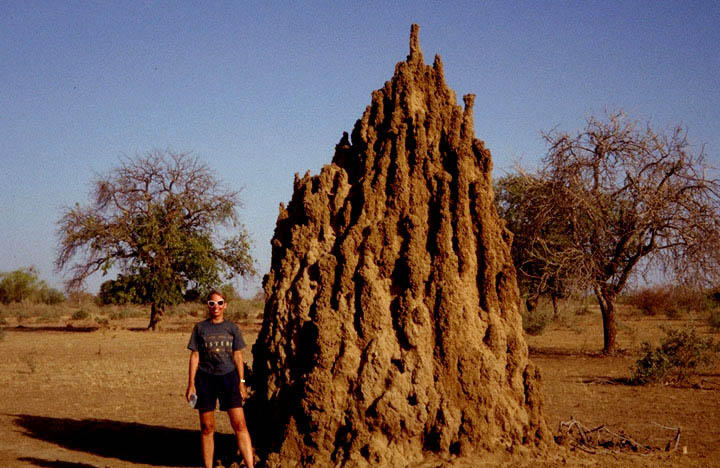
I wonder what a city landscape would look like if it was populated with buildings that all looked like this. To me, it would look like an artist version of an alien planet.
The question that haunts me in this age of peer to peer collaborations, with dependence upon emergent behavior from a large group of individuals, is the results may be functional, but will they be beautiful? Or, is beauty as a concept simply going to disappear? Or will we see functionality as beauty?
Morrison was interested in another question, "Could the termites eventually build a telescope?"
Even though termites can construct arches, could they ever build a cathedral?
More to the point, could we, if we operated in like manner?
What are the limits of free, open collaborative systems? It's hard to image any of modern civilizations greatest projects being completed in this manner.
Open Space Technology
What is an Open Space Technology meeting?
Open Space Technology has been defined as:
* a simple, powerful way to catalyze effective working conversations and truly inviting organizations -- to thrive in times of swirling change.
* a methodological tool that enables self-organizing groups of all sizes to deal with hugely complex issues in a very short period of time.
* a powerful group process that supports positive transformation in organizations, increases productivity, inspires creative solutions, improves communication and enhances collaboration.
* the most effective process for organizations and communities to identify critical issues, voice to their passions and concerns, learn from each other, and, when appropriate, take collective responsibility for finding solutions.
The goal of an Open Space Technology meeting is to create time and space for people to engage deeply and creatively around issues of concern to them. The agenda is set by people with the power and desire to see it through, and typically, Open Space meetings result in transformative experiences for the individuals and groups involved.
What is Open Space Technology best used for?
Open Space Technology is useful in almost any context including strategic direction setting, envisioning the future, conflict resolution, morale building, consultation with stakeholders, community planning, collaboration and deep learning about issues and perspectives.
When is Open Space Technology the best meeting format to use?
Any situation in which there is:
* A real issue of concern
* Diversity of players
* Complexity of elements
* Presence of passion (including conflict)
* A need for a quick decision
Open Space will work under all of these circumstances. It is only inappropriate when the outcome of the meeting is predetermined or if sponsors are not prepared to change as a result of the meeting.
What outcomes can I expect from an Open Space Technology Meeting?
Open Space Technology meetings can produce the following deliverables:
* Every single issue that anybody cares about enough to raise will be "on the table".
* All issues will receive as much discussion as people care to give them.
* All discussion will be captured in a book, and made available to the participants.
* All issues will be prioritized.
* Related issues will be converged.
* Responsibility will be taken for next step actions.
In meetings of one and a half or two and a half days duration, all of these deliverables will be achieved with deep conversation and commitment to action. Meetings of a shorter duration will have many of these positive effects, but typically in meetings of a day or less, there is more emphasis on conversation and less on action.
How does an Open Space Technology meeting work?
Open Space operates under four principles and one law. The four principles are:
* Whoever comes are the right people
* Whatever happens is the only thing that could have happened.
* When it starts is the right time
* When it's over it's over
The Law is known as the Law of Two Feet:
"If you find yourself in a situation where you are not contributing or learning, move somewhere where you can."
The four principles and the law work to create a powerful event motivated by the passion and bounded by the responsibility of the participants.
From Chris Corrigan, Consulting in Organizational and Community Development, web site.
Oliver Markley brought Open Space to my attention. I have to read and study it before I can apply it to an Innovation Commons, but this web site summarized the process so well that I wanted to pass it along quickly.
There is also a Wiki.
Open Space Technology has been defined as:
* a simple, powerful way to catalyze effective working conversations and truly inviting organizations -- to thrive in times of swirling change.
* a methodological tool that enables self-organizing groups of all sizes to deal with hugely complex issues in a very short period of time.
* a powerful group process that supports positive transformation in organizations, increases productivity, inspires creative solutions, improves communication and enhances collaboration.
* the most effective process for organizations and communities to identify critical issues, voice to their passions and concerns, learn from each other, and, when appropriate, take collective responsibility for finding solutions.
The goal of an Open Space Technology meeting is to create time and space for people to engage deeply and creatively around issues of concern to them. The agenda is set by people with the power and desire to see it through, and typically, Open Space meetings result in transformative experiences for the individuals and groups involved.
What is Open Space Technology best used for?
Open Space Technology is useful in almost any context including strategic direction setting, envisioning the future, conflict resolution, morale building, consultation with stakeholders, community planning, collaboration and deep learning about issues and perspectives.
When is Open Space Technology the best meeting format to use?
Any situation in which there is:
* A real issue of concern
* Diversity of players
* Complexity of elements
* Presence of passion (including conflict)
* A need for a quick decision
Open Space will work under all of these circumstances. It is only inappropriate when the outcome of the meeting is predetermined or if sponsors are not prepared to change as a result of the meeting.
What outcomes can I expect from an Open Space Technology Meeting?
Open Space Technology meetings can produce the following deliverables:
* Every single issue that anybody cares about enough to raise will be "on the table".
* All issues will receive as much discussion as people care to give them.
* All discussion will be captured in a book, and made available to the participants.
* All issues will be prioritized.
* Related issues will be converged.
* Responsibility will be taken for next step actions.
In meetings of one and a half or two and a half days duration, all of these deliverables will be achieved with deep conversation and commitment to action. Meetings of a shorter duration will have many of these positive effects, but typically in meetings of a day or less, there is more emphasis on conversation and less on action.
How does an Open Space Technology meeting work?
Open Space operates under four principles and one law. The four principles are:
* Whoever comes are the right people
* Whatever happens is the only thing that could have happened.
* When it starts is the right time
* When it's over it's over
The Law is known as the Law of Two Feet:
"If you find yourself in a situation where you are not contributing or learning, move somewhere where you can."
The four principles and the law work to create a powerful event motivated by the passion and bounded by the responsibility of the participants.
From Chris Corrigan, Consulting in Organizational and Community Development, web site.
Oliver Markley brought Open Space to my attention. I have to read and study it before I can apply it to an Innovation Commons, but this web site summarized the process so well that I wanted to pass it along quickly.
There is also a Wiki.
Democratic Innovation
Jeff de Cagna writes in his blog, "Associations today face a potent and relentless adversary: profound change. Yes, it’s true, we’ve always faced change in our organizations, but not like this. The very nature of change itself is changing. Change today is more constant than episodic, more complex than clear, more non-linear than cyclical and it is occurring at a greatly accelerated pace. We find that in this environment many of the tried-and-true heuristics of association management are remarkably ineffectual and, sometimes, counterproductive. Unfortunately, far too many association leaders continue to struggle with the politics of incrementalism, cost-cutting and risk avoidance as they try to come up with fresh answers about what to do next.
In face of such harsh and unforgiving realities, staff and volunteer association leaders must respond in a way that is just as forceful and unyielding. But that response cannot come in the form of tips, tools or techniques for "managing change" or "doing more with less." That is just so much tinkering around the margins. Instead, what we need is a new ideology, a different system of beliefs that challenges us to rediscover the "plausible promise" of our organizations and to act confidently and decisively to make them relevant, renewable and resilient for the 21st Century.
For me, that ideology is what I call "innovation democracy." It is grounded in the fundamental conviction that, at their core, both innovation and associations are about freedom. Associations are about the freedom to collaborate, to serve and to act collectively on behalf of a worthwhile vision of what the world can be. And that is where innovation comes in. Innovation is about the freedom to imagine what is possible, to create it and, in so doing, make an enduring contribution to the world in which you live. In my view, one that is largely contrary to the prevailing orthodoxy of the association world, innovation and associations are intimately, if opaquely, connected."
He goes on to elaborate six principles of democratic innovation:
* Strategy is a coherent portfolio of experiments developed across the association
* Technology supports the social architecture of association innovation
* Association culture remains vibrant by emphasizing variety, transparency and inclusion.
* Curiosity, inquiry and discovery shape the association's intellectual property.
* A high "return on engagement' in the association drives financial investment.
* Association leaders create leaders by distributing responsibility for innovation.
In face of such harsh and unforgiving realities, staff and volunteer association leaders must respond in a way that is just as forceful and unyielding. But that response cannot come in the form of tips, tools or techniques for "managing change" or "doing more with less." That is just so much tinkering around the margins. Instead, what we need is a new ideology, a different system of beliefs that challenges us to rediscover the "plausible promise" of our organizations and to act confidently and decisively to make them relevant, renewable and resilient for the 21st Century.
For me, that ideology is what I call "innovation democracy." It is grounded in the fundamental conviction that, at their core, both innovation and associations are about freedom. Associations are about the freedom to collaborate, to serve and to act collectively on behalf of a worthwhile vision of what the world can be. And that is where innovation comes in. Innovation is about the freedom to imagine what is possible, to create it and, in so doing, make an enduring contribution to the world in which you live. In my view, one that is largely contrary to the prevailing orthodoxy of the association world, innovation and associations are intimately, if opaquely, connected."
He goes on to elaborate six principles of democratic innovation:
* Strategy is a coherent portfolio of experiments developed across the association
* Technology supports the social architecture of association innovation
* Association culture remains vibrant by emphasizing variety, transparency and inclusion.
* Curiosity, inquiry and discovery shape the association's intellectual property.
* A high "return on engagement' in the association drives financial investment.
* Association leaders create leaders by distributing responsibility for innovation.
Subscribe to:
Posts (Atom)