
Tuesday, September 16, 2008
Collaboration
Howard Rheingold talks about the coming world of collaboration, participatory media and collective action -- and how Wikipedia is really an outgrowth of our natural human instinct to work as a group.
Writer, artist and designer, theorist and community builder, Howard Rheingold is one of the driving minds behind our net-enabled, open, collaborative life.


Sunday, September 14, 2008
Ubiquity
This is not a hard book to read, but it is difficult to integrate into the way you look at the world. Mark Buchanan is a science writer who has worked on the editorial staff of Nature and as a features editor New Scientist. In this book he is writing about the development of a growing field of physics - complexity. Complexity is chaos in critical states. A critical state exists in a system that is not in equilibrium. You may have heard of the "butterfly effect". That is, there is a possibility that a butterfly flapping its wings in South America can cause a storm in Europe weeks later. However, that same butterfly can flap all in wants inside a closed balloon with no effects, other than maybe slightly increasing the temperature of the air in the balloon. The air inside the balloon is in equilibrium, even though the molecules exhibit chaotic behavior. The atmosphere is in a critical, i.e. non-equilibrium, state. A small perturbation somewhere can lead to very big changes.
If the air inside the balloon is in equilibrium, its past, present and future are all the same. It has no "history". When things are in non-equilibrium, history matters since what happens now can never be washed away but affects the entire course of the future.
The applications of this model extend from the piling of grains of sand in an hourglass to economics.
"Despite what scientists had previously believed, might the critical state in fact be quite common? Could riddling lines of instability of a logically equivalent sort run through the Earth's crust, for example, through forests and ecosystems, and perhaps even through the somewhat more abstract "fabric" of our economics? Think of those first few crumbling rocks near Kobe, or that first insignificant dip in prices that triggered the stock market crash of 1987. Might these have been "sand grains" acting at another level? Could the special organization of the critical state explain why the world at large seems so susceptible to unpredictable upheavals?
A decade of research by hundreds of other physicists has explored this question and taken the initial idea much further. There are many subtleties and twists in the story to which we shall come later in this book, but the basic message, roughly speaking, is simple: The peculiar and exceptionally unstable organization of the critical state does indeed seem to be ubiquitous in our world. Researchers in the past few years have found its mathematical fingerprints in the workings of all the upheavals I've mentioned so far, as well as in the spreading of epidemics, the flaring of traffic jams, the patterns by which instructions trickle down from managers to workers in an office, and in many other things. At the heart of our story, then, lies the discovery that networks of things of all atoms, molecules, species, people, and even ideas have a marked tendency to organize themselves along similar lines. On the basis of this insight, scientists are finally beginning to fathom what lies behind tumultuous events of all sorts, and to see patterns at work here where they have never seen them before."
The mathematical models of this science don't really exist yet, and may never exist. We have empirical observations and we have games. The empirical data suggests that all these phenomena follow a power curve, and all with roughly the same shape. For example, looking at earthquakes, as the strength of the earthquake doubles, the frequency of occurrence drops by one fourth. This simple rule seems to apply to many examples.
So what does this have to do with creativity, strategy, leadership and innovation in organization? Well, I'm not sure yet. My intuition tells me that this is very important to those concepts. It may help us understand the frequency of occurrence of breakthrough ideas and innovation. It may help explain why some innovations cause such change and others do not. It may help produce better strategies to deal with chaotic and unstable markets. And, it may provide lessons for leaders in chaotic times. I'd welcome a discussion.
Ubiquity: Why Catastrophes Happen
Mark Buchanan
Thee Rivers Press, 2000
273 pages
If the air inside the balloon is in equilibrium, its past, present and future are all the same. It has no "history". When things are in non-equilibrium, history matters since what happens now can never be washed away but affects the entire course of the future.
The applications of this model extend from the piling of grains of sand in an hourglass to economics.
"Despite what scientists had previously believed, might the critical state in fact be quite common? Could riddling lines of instability of a logically equivalent sort run through the Earth's crust, for example, through forests and ecosystems, and perhaps even through the somewhat more abstract "fabric" of our economics? Think of those first few crumbling rocks near Kobe, or that first insignificant dip in prices that triggered the stock market crash of 1987. Might these have been "sand grains" acting at another level? Could the special organization of the critical state explain why the world at large seems so susceptible to unpredictable upheavals?
A decade of research by hundreds of other physicists has explored this question and taken the initial idea much further. There are many subtleties and twists in the story to which we shall come later in this book, but the basic message, roughly speaking, is simple: The peculiar and exceptionally unstable organization of the critical state does indeed seem to be ubiquitous in our world. Researchers in the past few years have found its mathematical fingerprints in the workings of all the upheavals I've mentioned so far, as well as in the spreading of epidemics, the flaring of traffic jams, the patterns by which instructions trickle down from managers to workers in an office, and in many other things. At the heart of our story, then, lies the discovery that networks of things of all atoms, molecules, species, people, and even ideas have a marked tendency to organize themselves along similar lines. On the basis of this insight, scientists are finally beginning to fathom what lies behind tumultuous events of all sorts, and to see patterns at work here where they have never seen them before."
The mathematical models of this science don't really exist yet, and may never exist. We have empirical observations and we have games. The empirical data suggests that all these phenomena follow a power curve, and all with roughly the same shape. For example, looking at earthquakes, as the strength of the earthquake doubles, the frequency of occurrence drops by one fourth. This simple rule seems to apply to many examples.
So what does this have to do with creativity, strategy, leadership and innovation in organization? Well, I'm not sure yet. My intuition tells me that this is very important to those concepts. It may help us understand the frequency of occurrence of breakthrough ideas and innovation. It may help explain why some innovations cause such change and others do not. It may help produce better strategies to deal with chaotic and unstable markets. And, it may provide lessons for leaders in chaotic times. I'd welcome a discussion.
Ubiquity: Why Catastrophes Happen
Mark Buchanan
Thee Rivers Press, 2000
273 pages
Leading the Revolution
If you haven’t already read this book, you should read it now. It’s one of the best books on innovation I’ve read and innovation is the twelfth word in the long title. It’s also a book about strategy, that forgotten and banned word from business books. And, it’s courageous, full of things I wish I had written like, “…how many times have you heard a CEO or divisional vice president say, ’Our real problem is execution’? Or worse, tell people that ‘strategy is the easy part, implementation is the hard part.’ What rubbish! These worthless aphorisms are favored by executives afraid to admit that their strategies are seriously out of date, executive’s who’d prefer their people stop asking awkward questions and get back to work. Strategy is easy if you’re content to have a strategy that is a derivative of someone else’s strategy. Strategy is anything but easy if your goal is to be the author of industry transformation – again and again.”
The book is well written and full of gems of wisdom like:
"In a nonlinear world, only nonlinear ideas will create new wealth."
"By the time an organization has wrung the last 5 percent efficiency out of the how, someone else will have invented a new what."
"Somewhere out there there’s a bullet with your company’s name on it."
"The gap between what can be imagined and what can be accomplished has never been smaller."
We are limited not by our tools, but by our imagination.
"First the revolutionaries will take your markets and your customers Next they’ll take your best employees. Finally, they’ll take your assets."
"In the new industrial order, the battle is not democracy versus totalitarism or globalism versus tribalism, it is innovation versus precedent."
It is a call to “conscious” people in organizations to lead a revolution. The title says so in bold print on the cover. (I was walking through a hotel lobby with the book in my hand with the title clearly visible, a person that could have been someone attached to security stared at the book as I walked past.) He points out that for a company to embrace revolutionary change requires bottoms-up revolutionary thought and someone at the top supporting the change. The middle are almost always slaves to precedent. But, this is not a book aimed at executives, it is aimed at workers.
“Most of us pour more of our life into the vessel of work than into family, faith or community. Yet more often than not the return on emotional equity derived from work is meager. The nomadic Israelites were commanded by God to rest one day in seven – but he didn’t decree that the other six had to be empty of meaning. By what law must competitiveness come at the expense of hope?”
The opening paragraphs of the book encapsulate his view of the world of business:
“The age of progress is over. It was born in the Renaissance, achieved its exuberant adolescence during Enlightenment, reached a robust maturity in the industrial age, and died with the dawn of the twenty-first century. For countless millennia there was no progress, only cycles. Seasons turned. Generations came and went. Life didn’t get any better; it simply repeated itself in an endlessly familiar pattern. There was no future, for the future was indistinguishable from the past.
Then came the unshakeable belief that progress was not only possible, it was inevitable. Life spans would increase. Material comforts would multiply. Knowledge would grow. There was nothing that could not be improved upon. The discipline of reason and the deductive routines of science could be applied to every problem, from designing a more perfect union to produce semiconductors of mind boggling complexity and unerring quality.”
He continues, “We are now standing on the threshold of a new age – an age of revolution. Change has changed. No longer is it additive. No longer does it move in a straight line. In the twenty-first century, change is discontinuous, abrupt, seditious.”
And later, “It’s not that things didn’t change back there in the age of progress; they did” he continues, “But to use a metaphor from the theory of biological evolution, it was a world of punctuated equilibrium, where change was episodic. Today, we live in a world that is all punctuation and no equilibrium. To thrive in this new age, every company and every individual will have to become as nimble as change itself.”
He asks the question, “Who will create new wealth and who will squander the old?”
“Companies today are rightly obsessed with satisfying stockholders. Spin-offs, de-mergers, share buybacks, tracking stocks, value-based management programs – all these things release wealth, but they don’t create wealth. Neither do mega-mergers. These strategies don’t create new wealth because they don’t create new business models, new markets, new sources of competitive advantage or new customers. So while they may deliver onetime gains to shareholders, they don’t fundamentally change a company’s long-term earning potential. Industry revolutionaries are in the business of creating new wealth. You won’t find them playing shell games with shareholders. Any company that wants to thrive in the age of revolution is going to have to do more than wring a bit of wealth out of yesterday’s strategies. Revolutionaries don’t release wealth, they create it. They do more than conserve, they build.”
He continues, “In truth, CFOs and CEOs have been mistaken the scoreboard for the game. They have spent too much time trying to manipulate quarterly earnings and the share price, and too little time trying to build their company’s capacity for radical innovation. Shareholder wealth may be the scoreboard, but the game is radical innovation.”
Hamel makes the point convincingly that we are at the top of an economic s-curve. We’ve squeezed all incremental and imaginary costs out of present business strategy and it’s time for radical innovation, what he calls strategy decay. He also attacks the sameness of business strategies. Through the process of best practices, industries have reached centrality. All the businesses are all so close to each other strategically because they have for years determined best practices and adopted those in their own organization. Revolutionaries can break out of the pack and establish the new rules of competition.
“In the age of revolution, every company must become an opportunity seeking missile – where the guidance system homes in on what is possible, not on what has already been accomplished. A brutal honesty about strategy decay and a commitment to creating new wealth are foundations for strategy innovation. But you can’t be an industry revolutionary unless you’ve learned to see the unconventional. You won’t have the courage to abandon, even partially, what is familiar unless you feel in viscera the promise of the unconventional.”
Hamel doesn’t specifically define business concept innovation, but he does give us some of its characteristics. “The goal of business concept innovation is to introduce more strategic variety into an industry or competitive domain. When this happens, and when customers value that variety, the distribution of wealth-creating often shifts dramatically in favor of the innovator.” Later he writes, “Business concept innovation is meta-innovation, in that it changes the very basis for competition within an industry or domain.” Still later, “Business concept innovation starts from the premise that the only way to escape the squeeze of hyper competition, even temporarily is to build a business model so unlike what has come before that traditional competitors are left scrambling.”
To me a business concept innovation is a collection of product, process and procedure innovations with the right mix of incremental, distinctive and breakthrough change. If it is the right mix, i.e. the mix creates unusual value for the customer, then a shift of wealth occurs.
Hamel identifies four components of a business model – core strategy, strategic resources, customer interface and value network. He then unpacks his concept of a business model. He identifies four factors that determine a business model’s profitability (and its potential for wealth) – efficiency, uniqueness, fit and profit boosters. Along the way, he gives examples of radical innovation driven business models.
The book then turns and focuses on the individual, the revolutionary. He spends three chapters on advice to revolutionaries in Be Your Own Seer, Corporate Rebels and Go Ahead! Revolt! These chapters provide some really useful information for people who sense that revolutionary change is required, but aren’t sure what they can do about it.
He then turns his attention to revolution within old hierarchies in Gray-Haired Revolutionaries. He makes the point that an organization is never too old to change if they establish the right climate for change and provide the support and encouragement for rebels within the organization.
The book closes with Design Rules for Innovation and The New Innovation Solution. Hamel’s design rules for innovation are:
- Unreasonable expectations
- Elastic business definition
- A cause, not a business
- New voices
- A market for innovation
- Low risk experimentation
- Cellular division
- Connectivity
“Most companies use a decidedly unbalanced scorecard – one that is heavily weighted toward optimization rather than innovation. Measures like RONA, ROCE, EDVA and ROI often encourage managers to beat a dead horse ever harder.” These and other metrics are not pro-innovation. “Without strong pro-innovation metrics, the default setting in most organizations is ‘more of the same’” He continues, “Traditional metrics do not force a company to consider how it is performing against new and unorthodox competitors in the quest for wealth creation.”
Hamel’s suggestion for a radical business concept innovation metric is a Wealth Creation Index (WCI). “The WCI lets a company determine how it has performed against a relevant set of ‘competitors’ in creating new wealth. The process of determining your company’s WCI involves two steps: defining the domain and calculating changes in the market value of your company versus the value of the entire domain.”
This is a good start but I don’t believe it’s sufficient to guide a revolution. WCI is a measure of the consequences of previous actions. The examples he gives are over a ten year period. In my experience what is also needed are predictive and present metrics – people, processes, outcomes and consequences.
Hamel ends with a real call to revolutionaries, “Do you care enough about the future to argue with precedent and stick a thumb in the eye of tradition?” He continues with other exhortations ending with, “Do you care enough to lead the revolution?”
This is a powerful book crammed full of ideas. It’s a fun book to read, but a real bear to really understand and implement. My suggestion, if you think you want to be a revolutionary, find a group like your self, read this book and create a study group or discussion group.
The book has nine chapters divided into four sections:
Facing Up to the Revolution
1. The End of Progress
2. Facing Up to Strategy Decay
Finding the Revolution
3. Business Concept Innovation
4. Be Your Own Seer
Igniting the Revolution
5. Corporate Rebels
6. Go Ahead! Revolt!
Sustaining the Revolution
7. Gray-Haired Revolutionaries
8. Design Rules for Innovation
9. The New Innovation Solution
Leading the Revolution: How to thrive in Turbulent Times by Making Innovation a Way of Life, Gary Hamel, Plume Book, 2002, Paperback, 337 pages
The book is well written and full of gems of wisdom like:
"In a nonlinear world, only nonlinear ideas will create new wealth."
"By the time an organization has wrung the last 5 percent efficiency out of the how, someone else will have invented a new what."
"Somewhere out there there’s a bullet with your company’s name on it."
"The gap between what can be imagined and what can be accomplished has never been smaller."
We are limited not by our tools, but by our imagination.
"First the revolutionaries will take your markets and your customers Next they’ll take your best employees. Finally, they’ll take your assets."
"In the new industrial order, the battle is not democracy versus totalitarism or globalism versus tribalism, it is innovation versus precedent."
It is a call to “conscious” people in organizations to lead a revolution. The title says so in bold print on the cover. (I was walking through a hotel lobby with the book in my hand with the title clearly visible, a person that could have been someone attached to security stared at the book as I walked past.) He points out that for a company to embrace revolutionary change requires bottoms-up revolutionary thought and someone at the top supporting the change. The middle are almost always slaves to precedent. But, this is not a book aimed at executives, it is aimed at workers.
“Most of us pour more of our life into the vessel of work than into family, faith or community. Yet more often than not the return on emotional equity derived from work is meager. The nomadic Israelites were commanded by God to rest one day in seven – but he didn’t decree that the other six had to be empty of meaning. By what law must competitiveness come at the expense of hope?”
The opening paragraphs of the book encapsulate his view of the world of business:
“The age of progress is over. It was born in the Renaissance, achieved its exuberant adolescence during Enlightenment, reached a robust maturity in the industrial age, and died with the dawn of the twenty-first century. For countless millennia there was no progress, only cycles. Seasons turned. Generations came and went. Life didn’t get any better; it simply repeated itself in an endlessly familiar pattern. There was no future, for the future was indistinguishable from the past.
Then came the unshakeable belief that progress was not only possible, it was inevitable. Life spans would increase. Material comforts would multiply. Knowledge would grow. There was nothing that could not be improved upon. The discipline of reason and the deductive routines of science could be applied to every problem, from designing a more perfect union to produce semiconductors of mind boggling complexity and unerring quality.”
He continues, “We are now standing on the threshold of a new age – an age of revolution. Change has changed. No longer is it additive. No longer does it move in a straight line. In the twenty-first century, change is discontinuous, abrupt, seditious.”
And later, “It’s not that things didn’t change back there in the age of progress; they did” he continues, “But to use a metaphor from the theory of biological evolution, it was a world of punctuated equilibrium, where change was episodic. Today, we live in a world that is all punctuation and no equilibrium. To thrive in this new age, every company and every individual will have to become as nimble as change itself.”
He asks the question, “Who will create new wealth and who will squander the old?”
“Companies today are rightly obsessed with satisfying stockholders. Spin-offs, de-mergers, share buybacks, tracking stocks, value-based management programs – all these things release wealth, but they don’t create wealth. Neither do mega-mergers. These strategies don’t create new wealth because they don’t create new business models, new markets, new sources of competitive advantage or new customers. So while they may deliver onetime gains to shareholders, they don’t fundamentally change a company’s long-term earning potential. Industry revolutionaries are in the business of creating new wealth. You won’t find them playing shell games with shareholders. Any company that wants to thrive in the age of revolution is going to have to do more than wring a bit of wealth out of yesterday’s strategies. Revolutionaries don’t release wealth, they create it. They do more than conserve, they build.”
He continues, “In truth, CFOs and CEOs have been mistaken the scoreboard for the game. They have spent too much time trying to manipulate quarterly earnings and the share price, and too little time trying to build their company’s capacity for radical innovation. Shareholder wealth may be the scoreboard, but the game is radical innovation.”
Hamel makes the point convincingly that we are at the top of an economic s-curve. We’ve squeezed all incremental and imaginary costs out of present business strategy and it’s time for radical innovation, what he calls strategy decay. He also attacks the sameness of business strategies. Through the process of best practices, industries have reached centrality. All the businesses are all so close to each other strategically because they have for years determined best practices and adopted those in their own organization. Revolutionaries can break out of the pack and establish the new rules of competition.
“In the age of revolution, every company must become an opportunity seeking missile – where the guidance system homes in on what is possible, not on what has already been accomplished. A brutal honesty about strategy decay and a commitment to creating new wealth are foundations for strategy innovation. But you can’t be an industry revolutionary unless you’ve learned to see the unconventional. You won’t have the courage to abandon, even partially, what is familiar unless you feel in viscera the promise of the unconventional.”
Hamel doesn’t specifically define business concept innovation, but he does give us some of its characteristics. “The goal of business concept innovation is to introduce more strategic variety into an industry or competitive domain. When this happens, and when customers value that variety, the distribution of wealth-creating often shifts dramatically in favor of the innovator.” Later he writes, “Business concept innovation is meta-innovation, in that it changes the very basis for competition within an industry or domain.” Still later, “Business concept innovation starts from the premise that the only way to escape the squeeze of hyper competition, even temporarily is to build a business model so unlike what has come before that traditional competitors are left scrambling.”
To me a business concept innovation is a collection of product, process and procedure innovations with the right mix of incremental, distinctive and breakthrough change. If it is the right mix, i.e. the mix creates unusual value for the customer, then a shift of wealth occurs.
Hamel identifies four components of a business model – core strategy, strategic resources, customer interface and value network. He then unpacks his concept of a business model. He identifies four factors that determine a business model’s profitability (and its potential for wealth) – efficiency, uniqueness, fit and profit boosters. Along the way, he gives examples of radical innovation driven business models.
The book then turns and focuses on the individual, the revolutionary. He spends three chapters on advice to revolutionaries in Be Your Own Seer, Corporate Rebels and Go Ahead! Revolt! These chapters provide some really useful information for people who sense that revolutionary change is required, but aren’t sure what they can do about it.
He then turns his attention to revolution within old hierarchies in Gray-Haired Revolutionaries. He makes the point that an organization is never too old to change if they establish the right climate for change and provide the support and encouragement for rebels within the organization.
The book closes with Design Rules for Innovation and The New Innovation Solution. Hamel’s design rules for innovation are:
- Unreasonable expectations
- Elastic business definition
- A cause, not a business
- New voices
- A market for innovation
- Low risk experimentation
- Cellular division
- Connectivity
“Most companies use a decidedly unbalanced scorecard – one that is heavily weighted toward optimization rather than innovation. Measures like RONA, ROCE, EDVA and ROI often encourage managers to beat a dead horse ever harder.” These and other metrics are not pro-innovation. “Without strong pro-innovation metrics, the default setting in most organizations is ‘more of the same’” He continues, “Traditional metrics do not force a company to consider how it is performing against new and unorthodox competitors in the quest for wealth creation.”
Hamel’s suggestion for a radical business concept innovation metric is a Wealth Creation Index (WCI). “The WCI lets a company determine how it has performed against a relevant set of ‘competitors’ in creating new wealth. The process of determining your company’s WCI involves two steps: defining the domain and calculating changes in the market value of your company versus the value of the entire domain.”
This is a good start but I don’t believe it’s sufficient to guide a revolution. WCI is a measure of the consequences of previous actions. The examples he gives are over a ten year period. In my experience what is also needed are predictive and present metrics – people, processes, outcomes and consequences.
Hamel ends with a real call to revolutionaries, “Do you care enough about the future to argue with precedent and stick a thumb in the eye of tradition?” He continues with other exhortations ending with, “Do you care enough to lead the revolution?”
This is a powerful book crammed full of ideas. It’s a fun book to read, but a real bear to really understand and implement. My suggestion, if you think you want to be a revolutionary, find a group like your self, read this book and create a study group or discussion group.
The book has nine chapters divided into four sections:
Facing Up to the Revolution
1. The End of Progress
2. Facing Up to Strategy Decay
Finding the Revolution
3. Business Concept Innovation
4. Be Your Own Seer
Igniting the Revolution
5. Corporate Rebels
6. Go Ahead! Revolt!
Sustaining the Revolution
7. Gray-Haired Revolutionaries
8. Design Rules for Innovation
9. The New Innovation Solution
Leading the Revolution: How to thrive in Turbulent Times by Making Innovation a Way of Life, Gary Hamel, Plume Book, 2002, Paperback, 337 pages
Russia in Search of Itself
This is a great book, very readable with wonderful insights into Russia's past, present and potential futures.
This is not a book review for this short piece could not do justice to this important book. Rather this essay develops just one line of thought from the book about the concept of sobornost' - an idea that may have some bearing on the innovation commons.
In the 1920s, Vladimir Vernadsky developed "his increasingly visionary idea that man was not only an organic part of the biosphere but also an immaterial force in the 'noosphere', where everything is determined by the interaction between the human mind and the material world. Multiple conferences and even special institutes have arisen in post Soviet Russia to discuss the moral and spiritual implications of living in the noosphere. The discussion has involved more people more deeply in Russia than did the earlier consideration of the similar ideas of Teilhard de Chardin in the West."
Later, Billington writes, "Ivanov sees in the concept of the noosphere the key to global collaboration both in solving common problems and in restoring the imbalance in modern culture between the two hemispheres of the brain. 'The current high status of the left side of the brain' results from the written, alphabetized means of communication that supplanted humanity's earlier oral and pictorial ways of communicating. The new audiovisual culture of the late twentieth century opens up the possibility of restoring the right side of the brain to a co-equal role. Harmony within the individual could facilitate harmony in the noosphere."
He continues, "In the later Soviet era, V. V. Ivanov had helped pioneer the innovative movement of humanistic scholarship called semiotics (the science of signs). Seeking to apply the discipline of linguistics to other forms of human thought and expression, this informal school met in the relatively free atmosphere of Tartu, Estonia... Semiotics was seen as a means of unifying knowledge, and of rendering the noosphere intelligible as a 'semiosphere'."
In March 2002 Alexander Dugin, in describing his new Eurasia political party, believed that "Intensive scientific development in this Union will lead Eurasia both forward to economic modernization and back to traditional village values. And the Internet will permit economic activity to return from decadent cities to healthy rural locations."
In writing about Russia's travails in search of a democratic identity, Billington writes, Some advocates of a democratic rather than an authoritarian future for Russia buttress their case with new theories about the 'noosphere'. The prolific economist Yury Yahovets argues that all past theories about inevitable conflicts and the rise and fall of civilizations are now obsolete. The broad cycles in human affairs (the sociosphere) and in the natural world (the biosphere) are being superceded by the interaction of the human mind with the cosmos (the noosphere). All of mankind is now reaching 'through the storms to the stars'.
The ecological crisis has become global and cannot be resolved by either arrogant central planners or the 'uncontrollable randomness of the market'. Nor can one rely on the naive 'eco-centrism' of those who see science and technology as part of the problem rather than part of the solution. Questions must now be resolved collaboratively between nations and disciplines in the noosphere, 'the sphere that determines the influences of human thought and activity on biospheric processes'.
...Russia has the resources and talent to replicate this model on a larger scale and validate it for multiethnic countries - and perhaps even for the world as a whole."
Later, he introduces the concept of sobornost', "The spirit of togetherness engendered by local, cooperative activity was seen by many Russians as the expression of an indigenous tradition that they call sobornost'. This is a Slavophile-originated term derived from the word sobor, a word with multiple meanings of cathedral, council, and the simple gathering in of people or of things that had previously been scattered. It expresses a desire to find a measure of common purpose for a people and a culture long rent with splits and schisms. It provides a post-Soviet generation with a social ideal that is different from either Eastern collectivism or Western individualism. And it suggests that there is a spiritual dimension to nonpolitical, small-scale human community.
The basic human embodiment of the sobornost' ideal is the family. Family happiness was the ideal of much nineteenth-century Russian literature. The persistent integrity of the family throughout the twentieth century protected the Russian people from some of the intrusive inhumanity of the Soviet system. But sobernost' is thought to be exemplified in a wide variety of communal undertakings ranging from the camaraderie of pioneering construction work in harsh climates to the intense discussion of proscribed ideals in small urban circles.
Semion Frank, one of the most important neglected thinkers of the late imperial period, argued in the emigration that sobornost', 'the choral principle in Russian life', was not just an ideal from the past but a force for the future. Sobornost' overcame the potential hostility between the I and Thou with a kind of organic, spiritual unity that differed from 'sociality' (obshchestvernost') in which isolated individuals are aggregated into materialistic interest groups.
...sobornost' describes the kind of communion with others that is open to an individual seeking to discover what St. Augustine described as that which is within me which is deeper than myself. For others seeking a 'third way' between socialism and capitalism, sobornost' represents an indigenous communitarian ideal on which to base a humane, social democratic future."
In his conclusion, Billington writes, "Frank's belief that sobornost' begins with spiritual transformation within individuals rather than material changes in society...All of these Russian thinkers - and many others yet to be discovered - contribute not just to their own, but also to European and world civilization."
Russia: In Search of Itself
James H. Billington
Woodrow Wilson Press, 2004
This is not a book review for this short piece could not do justice to this important book. Rather this essay develops just one line of thought from the book about the concept of sobornost' - an idea that may have some bearing on the innovation commons.
In the 1920s, Vladimir Vernadsky developed "his increasingly visionary idea that man was not only an organic part of the biosphere but also an immaterial force in the 'noosphere', where everything is determined by the interaction between the human mind and the material world. Multiple conferences and even special institutes have arisen in post Soviet Russia to discuss the moral and spiritual implications of living in the noosphere. The discussion has involved more people more deeply in Russia than did the earlier consideration of the similar ideas of Teilhard de Chardin in the West."
Later, Billington writes, "Ivanov sees in the concept of the noosphere the key to global collaboration both in solving common problems and in restoring the imbalance in modern culture between the two hemispheres of the brain. 'The current high status of the left side of the brain' results from the written, alphabetized means of communication that supplanted humanity's earlier oral and pictorial ways of communicating. The new audiovisual culture of the late twentieth century opens up the possibility of restoring the right side of the brain to a co-equal role. Harmony within the individual could facilitate harmony in the noosphere."
He continues, "In the later Soviet era, V. V. Ivanov had helped pioneer the innovative movement of humanistic scholarship called semiotics (the science of signs). Seeking to apply the discipline of linguistics to other forms of human thought and expression, this informal school met in the relatively free atmosphere of Tartu, Estonia... Semiotics was seen as a means of unifying knowledge, and of rendering the noosphere intelligible as a 'semiosphere'."
In March 2002 Alexander Dugin, in describing his new Eurasia political party, believed that "Intensive scientific development in this Union will lead Eurasia both forward to economic modernization and back to traditional village values. And the Internet will permit economic activity to return from decadent cities to healthy rural locations."
In writing about Russia's travails in search of a democratic identity, Billington writes, Some advocates of a democratic rather than an authoritarian future for Russia buttress their case with new theories about the 'noosphere'. The prolific economist Yury Yahovets argues that all past theories about inevitable conflicts and the rise and fall of civilizations are now obsolete. The broad cycles in human affairs (the sociosphere) and in the natural world (the biosphere) are being superceded by the interaction of the human mind with the cosmos (the noosphere). All of mankind is now reaching 'through the storms to the stars'.
The ecological crisis has become global and cannot be resolved by either arrogant central planners or the 'uncontrollable randomness of the market'. Nor can one rely on the naive 'eco-centrism' of those who see science and technology as part of the problem rather than part of the solution. Questions must now be resolved collaboratively between nations and disciplines in the noosphere, 'the sphere that determines the influences of human thought and activity on biospheric processes'.
...Russia has the resources and talent to replicate this model on a larger scale and validate it for multiethnic countries - and perhaps even for the world as a whole."
Later, he introduces the concept of sobornost', "The spirit of togetherness engendered by local, cooperative activity was seen by many Russians as the expression of an indigenous tradition that they call sobornost'. This is a Slavophile-originated term derived from the word sobor, a word with multiple meanings of cathedral, council, and the simple gathering in of people or of things that had previously been scattered. It expresses a desire to find a measure of common purpose for a people and a culture long rent with splits and schisms. It provides a post-Soviet generation with a social ideal that is different from either Eastern collectivism or Western individualism. And it suggests that there is a spiritual dimension to nonpolitical, small-scale human community.
The basic human embodiment of the sobornost' ideal is the family. Family happiness was the ideal of much nineteenth-century Russian literature. The persistent integrity of the family throughout the twentieth century protected the Russian people from some of the intrusive inhumanity of the Soviet system. But sobernost' is thought to be exemplified in a wide variety of communal undertakings ranging from the camaraderie of pioneering construction work in harsh climates to the intense discussion of proscribed ideals in small urban circles.
Semion Frank, one of the most important neglected thinkers of the late imperial period, argued in the emigration that sobornost', 'the choral principle in Russian life', was not just an ideal from the past but a force for the future. Sobornost' overcame the potential hostility between the I and Thou with a kind of organic, spiritual unity that differed from 'sociality' (obshchestvernost') in which isolated individuals are aggregated into materialistic interest groups.
...sobornost' describes the kind of communion with others that is open to an individual seeking to discover what St. Augustine described as that which is within me which is deeper than myself. For others seeking a 'third way' between socialism and capitalism, sobornost' represents an indigenous communitarian ideal on which to base a humane, social democratic future."
In his conclusion, Billington writes, "Frank's belief that sobornost' begins with spiritual transformation within individuals rather than material changes in society...All of these Russian thinkers - and many others yet to be discovered - contribute not just to their own, but also to European and world civilization."
Russia: In Search of Itself
James H. Billington
Woodrow Wilson Press, 2004
P to P and Human Evolution
P2P and Human Evolution: Peer to Peer as the Premise of a New Mode of Civilization
Michel Bauwens
"The following essay describes the emergence, or expansion, of a specific type of relational dynamic, which I call peer to peer. It’s a form of human network-based organization which rests upon the free participation of equipotent partners, engaged in the production of common resources, without recourse to monetary compensation as key motivating factor, and not organized according to hierarchical methods of command and control. This format is emerging throughout the social field: as a format of technology (the point to point internet, file sharing, grid computing, the Writeable Web initiatives, blogs), as a third mode of production which is also called Commons-based peer production (neither centrally planned nor profit-driven), producing hardware, software (often called Free Libre Open Sources Software or FLOSS) and intellectual and cultural resources (wetware) that are of great value to humanity (GNU/Linux, Wikipedia), and as a general mode of knowledge exchange and collective learning which is massively practiced on the internet. It also emerges as new organizational formats in politics, spirituality; as a new ‘culture of work’. This essay thus traces the expansion of this format, seen as a "isomorphism" (= having the same format), in as many fields as possible. But it does more than that: it tries to provide an explanatory framework of why it is emerging now, and how it fits in a wider evolutionary framework."
This is the first paragraph of an extraordinary essay written by Michel Bauwens. He considers P2P as the technological framework of what he calls "Cognitive Capitalism", a new evolutionary form of capitalism (the first two being merchant capitalism and industrial capitalism), P2P in the economic sphere, P2P in the political sphere, P2P in the cosmic sphere, P2P in the sphere of culture and self, and P2P and social change. The essay is 44 pages loaded with new thoughts. Ideas and networks of ideas spin fluidly from his writing. At this point, I have no way of knowing whether is right or not, but his ideas are provocative and certainly worth learning and discussing.
He makes the bold assertion that "P2P is nothing less than a premise of a new type of civilization that is not exclusively geared towards the profit motive."
The framework he uses is based on Ken Wilber's four quadrant system - subjective (evolution of self and subjectivity), materiality of a single organism (objectivity), intersubjective (the interaction of groups of subjectivities and the worldviews and cultures they create), and interobjective (behaviors of groups).
"My modified form of the four-quadrant system starts with the 'exterior-individual', i.e. single objects in space and time, i.e. the evolution of the material basis of the universe, life, and mind (the evolution from atoms to molecules to cells etc..), but in my personal modification, this quadrant includes technological evolution, as I (and others such as McLuhan) can legitimately see technology as an extension of the human body. Second, we will look at the systems (exterior-collective) quadrant: the evolution of natural, political, economic, social and organizational systems. Third, we will look at the exterior-collective quadrant: human culture, spiritualities, philosophies, worldviews. In the fourth quadrant we will be discussing the interior-individual aspects, and we look at changes occurring within the sphere of the self. However, in practice, despite my stated intention, I have found it difficult to separate individual and collective aspects of subjectivity and they are provisionally treated in one section. That this is so is not surprising, since one of the aspects of peer to peer is it participative nature, which sees the individual always-already embedded in social processes."
He defines peer to peer in this way. " It is a specific form of relational dynamic, is based on the assumed equipotency of its participants, organized through the free cooperation of equals in view of the performance of a common task, for the creation of a common good. P2P is a network, not a hierarchy; it is decentralized; it a specific form of network using distributive intelligence: intelligence is located at any center, but everywhere within the system. Assumed equipotency means that P2P systems start from the premise that 'it doesn't know where the needed resource will be located', it assumes that 'everybody' can cooperate, and does not use formal rules in advance to determine its participating members. Equipotency, i.e. the capacity to cooperate, is verified in the process of cooperation itself. Validation of knowledge, acceptance of processes, are determined by the collective. Cooperation must be free, not forced, and not based on neutrality (i.e. the buying of cooperation in a monetary system). It exists to produce something. These are a number of characteristics that we can use to describe P2P systems 'in general', and in particular as it emerges in the human lifeworld. To have a good understanding of P2P, I suggest the following mental exercise, think about these characteristics, then about their opposites. So doing, the radical innovative nature of P2P springs to mind. Though P2P is related to earlier social modes, those were most in evidence in the early tribal era, and it now emerges in an entirely new context, enabled by technologies which go beyond the barriers of time and space. After the dominance during the last several millennia, of centralized and hierarchical modes of social organization, it is thus in many ways now a radically innovative emergence, and also reflects a very deep change in the epistemological and ontological paradigms that determine behavior and worldviews."
His conclusion is that "P2P networks are the key format of the technological infrastructure that supports the current economic, political and social systems."
He explains that P2P is a result of abundance - the abundance of information and its flow. Hierarchical systems create bottlenecks in the flow of abundant information. "Hierarchy only works with scarcity, and in a situation where the control of scarce resources determines the end result of the zero-sum power games being conducted. In a situation of abundance, centralized nodes cannot possible cope. Information, I probably do not need to remind the reader of this, is different from material goods, in that its sharing does not diminish its value, but on the contrary augments it."
He makes the key point that with an abundance of information and its relationship to complexity, P2P systems are the most effective and efficient means of solving problems. "Abundance is again both a cause and a consequence of complexity. In a situation of a multiplication of flows, flows that no longer follow predetermined routes, it cannot possible be predicted, where the 'solution' for any problem lies. Expertise comes out of a precise combination of experience, which is unpredictable in advance. Thus, systems are needed that allow expertise to unexpectedly announce itself, when it learns that it is needed. This is precisely what P2P systems allow to an unprecedented degree."
Later, Bauwens describes the work of Benkler and Krowne providing background for the emergence of P2P:
"Yochai Benkler, in a famous essay, 'Coase's Penguin', has given a rationale for the emergence of P2P production methodologies, based on the ideas of 'transaction cost'. In the physical world, the cost of bringing together thousands of participants may be very high, and so it may be cheaper to have centralized firms than an open market. This is why earlier experiences with collectivized economies could not work. But in the immaterial sphere used for the production of informational goods, the transaction goods are near-zero and therefore, open source production methods are cheaper and more efficient.
Aaron Krowne, writing for Free Software magazine, has proposed a set of laws to explain the higher efficiency of CBPP (= Commons-based peer production) models:
(Law 1.) When positive contributions exceed negative contributions by a sufficient factor in a CBPP project, the project will be successful.
This means that for every contributor that can 'mess things up', there have to be at least 10 others who can correct these mistakes. But in most projects the ration is 1 to 100 or 1 to 1000, so that quality can be maintained and improved over time.
(Law 2.) Cohesion quality is the quality of the presentation of the concepts in a collaborative component (such as an encyclopedia entry). Assuming the success criterion of Law 1 is met, cohesion quality of a component will overall rise. However, it may temporarily decline. The declines are by small amounts and the rises are by large amounts.
Individual contributions which may be useful by themselves but diminish the overall balance of the project, will always be discovered, so that decline can only be temporary.
(Corollary.) Laws 1 and 2 explain why cohesion quality of the entire collection (or project) increases over time: the uncoordinated temporary declines in cohesion quality cancel out with small rises in other components, and the less frequent jumps in cohesion quality accumulate to nudge the bulk average upwards. This is without even taking into account coverage quality, which counts any conceptual addition as positive, regardless of the elegance of its integration.
Krowne has also done useful work to define the authority models at work in such projects. The models define access and the workflow, and whether there is any quality control. The free-form model, which Wikipedia employs, allows anyone to edit any entry at any time. But in the owner-centric model, entries can only be modified with the permission of a specific 'owner' who has to defend the integrity of his module."
The author's view is that the owner-centric model is better for quality, but takes more time, while the free-form model increases the scope of coverage and is very fast.
He makes the point that scarcity is a construct of people. " We should also see that scarcity is in many ways a social construction. Nature was abundant to the tribal peoples, but when it was transformed into land that counted as property, land became scarce and a resource to be fought for. The enclosures movement in England was designed to precisely that. Out of land, previously plentiful resources were taken, and transformed into the form of property known as capital. Capital became scarce and to be fought for. Similarly today, the plentiful information commons that we produce, is being fought, so that it can turn into intellectual property, that can artificially be rendered scarce."
To explain the evolution of cooperation, he uses Edward Haskell's model - adversarial, neutral and synergistic cooperation. He points out that premodern imperial and feudal forms of society were based on adversarial form of cooperation. Cooperation was obtained by use of force. It was win-lose and the sum of 1 + 1 is always less than 2 in this type of cooperation. Capitalism introduced the neutral form of cooperation - the exchange of labor for fair compensation and a fair price for goods. At best capitalism is average. "Participants give just their money's worth. Neither participant in a neutral exchange gets better, 1 plus 1 equals 2."
However, P2P can result in synergistic cooperation, where 1 + 1> 2. "By definition, peer to peer processes are mobilized for common projects that are of greater use value to the wider community (since monetized exchange value falls away). True and authentic P2P therefore logically transforms into a win-win-win model, whereby not only the parties gain, but the wider community and social field as well. It is, in Edward Haskell's definition, a true synergetic cooperation. It is very important to see the 'energetic' effects of these different forms of cooperation, as I indicated above: 1) forced cooperation yields very low quality contributions; 2) the neutral cooperation format of the marketplace generates average quality contributions; 3) but freely given synergistic cooperation generates passion. Participants are automatically drawn to what they do best, at the moments at which they are most passionate and energetic about it. This is one of the fundamental reasons of the superior quality which is eventually, over time, created through open source projects."
Bauwens introduces the concept of rapport. "Arthur Coulter, author of a book on synergetics, adds a further twist explaining the superiority of P2P. He adds to the objective definition of Haskell, the subjective definition of 'rapport' based on the attitudes of the participants. Rapport is the state of persons who are in full agreement, and is determined by synergy (S), empathy (E), and communication (C). Synergy refers to interactions that promote the goals and efforts of the participants; empathy to the mutual understanding of the goals; and communication to the effective interchange of the data. His "Principle of Equivalence" states that the flow of S + E + C are optimal when they have equivalent status to each other." From this, he concludes that an egalitarian-supportive attitude is congenial to the success of P2P.
The author succinctly describes the difference between a market and P2P. "A market is based on the exchange of scarce goods, through a monetary mechanism. This is not the case for P2P products, which can be downloaded for free. They are not made for the profit obtained from the exchange value, but for their use value and acceptance by a user community."
In discussing freedom, he writes, "P2P is predicated on the maximum freedom. The freedom to join and participate, to fully express oneself and one's potential, the freedom to change course at any point in time, the freedom to quit. Within the common projects, freedom is constrained through communal validation and consensus (i.e. the freedom of others). But individuals can always leave, fork to a new project, create their own. The challenge is to find affinities, to create a common sphere with at least a few others and to create effective use value. Unlike in representative democracy, it is not a model based on a majority imposing its will on a minority."
He asserts that there is an emergence of a new form of power. "With the emergence of the Internet and peer to peer processes, yet a new form of power emerges, and Kumon calls it the Wisdom Game. In order to have influence, one must give quality knowledge away, and thus build reputation, through the demonstration of one's 'Wisdom'. The more one shares, the more this material is used by others, the higher one's reputation, the bigger one's influence."
He considers P2P as a new form of social exchange, "...what it reflects is an expansion of ethics: the desire to create and share, to produce something useful. The individual who joins a P2P project, puts his being, unadulterated, in the service of the construction of a common resource. Implicit is not just a concern for the narrow group, not just intersubjective relations, but the whole social field surrounding it.
Imagine a successful meeting of minds: individual ideas are confronted, but also changed in the process, through the free association born of the encounter with other intelligences. Thus eventually a common idea emerges, that has integrated the differences, not subsumed them. The participants do not feel they have made concessions or compromises, but feel that the new common integration is based on their ideas. There has been no minority, which has succumbed to the majority. There has been no 'representation', or loss of difference. Such is the true process of peer to peer.
An important philosophical change has been the abandonment of the unifying universalism of the Enlightenment project. Universality was to be attained by striving to unity, by the transcendence of representation of political power. But this unity meant sacrifice of difference. Today, the new epistemological and ontological requirement that P2P reflects, is not abstract universalism, but the concrete universality of a commons which has not sacrificed difference. This is the truth that the new concept of multitude, developed by Toni Negri and inspired by Spinoza, expresses. P2P is not predicated on representation and unity, but of the full expression of difference."
To read the entire essay, click here.
http://www.networkcultures.org/weblog/archives/P2P_essay.pdf
Michel Bauwens
"The following essay describes the emergence, or expansion, of a specific type of relational dynamic, which I call peer to peer. It’s a form of human network-based organization which rests upon the free participation of equipotent partners, engaged in the production of common resources, without recourse to monetary compensation as key motivating factor, and not organized according to hierarchical methods of command and control. This format is emerging throughout the social field: as a format of technology (the point to point internet, file sharing, grid computing, the Writeable Web initiatives, blogs), as a third mode of production which is also called Commons-based peer production (neither centrally planned nor profit-driven), producing hardware, software (often called Free Libre Open Sources Software or FLOSS) and intellectual and cultural resources (wetware) that are of great value to humanity (GNU/Linux, Wikipedia), and as a general mode of knowledge exchange and collective learning which is massively practiced on the internet. It also emerges as new organizational formats in politics, spirituality; as a new ‘culture of work’. This essay thus traces the expansion of this format, seen as a "isomorphism" (= having the same format), in as many fields as possible. But it does more than that: it tries to provide an explanatory framework of why it is emerging now, and how it fits in a wider evolutionary framework."
This is the first paragraph of an extraordinary essay written by Michel Bauwens. He considers P2P as the technological framework of what he calls "Cognitive Capitalism", a new evolutionary form of capitalism (the first two being merchant capitalism and industrial capitalism), P2P in the economic sphere, P2P in the political sphere, P2P in the cosmic sphere, P2P in the sphere of culture and self, and P2P and social change. The essay is 44 pages loaded with new thoughts. Ideas and networks of ideas spin fluidly from his writing. At this point, I have no way of knowing whether is right or not, but his ideas are provocative and certainly worth learning and discussing.
He makes the bold assertion that "P2P is nothing less than a premise of a new type of civilization that is not exclusively geared towards the profit motive."
The framework he uses is based on Ken Wilber's four quadrant system - subjective (evolution of self and subjectivity), materiality of a single organism (objectivity), intersubjective (the interaction of groups of subjectivities and the worldviews and cultures they create), and interobjective (behaviors of groups).
"My modified form of the four-quadrant system starts with the 'exterior-individual', i.e. single objects in space and time, i.e. the evolution of the material basis of the universe, life, and mind (the evolution from atoms to molecules to cells etc..), but in my personal modification, this quadrant includes technological evolution, as I (and others such as McLuhan) can legitimately see technology as an extension of the human body. Second, we will look at the systems (exterior-collective) quadrant: the evolution of natural, political, economic, social and organizational systems. Third, we will look at the exterior-collective quadrant: human culture, spiritualities, philosophies, worldviews. In the fourth quadrant we will be discussing the interior-individual aspects, and we look at changes occurring within the sphere of the self. However, in practice, despite my stated intention, I have found it difficult to separate individual and collective aspects of subjectivity and they are provisionally treated in one section. That this is so is not surprising, since one of the aspects of peer to peer is it participative nature, which sees the individual always-already embedded in social processes."
He defines peer to peer in this way. " It is a specific form of relational dynamic, is based on the assumed equipotency of its participants, organized through the free cooperation of equals in view of the performance of a common task, for the creation of a common good. P2P is a network, not a hierarchy; it is decentralized; it a specific form of network using distributive intelligence: intelligence is located at any center, but everywhere within the system. Assumed equipotency means that P2P systems start from the premise that 'it doesn't know where the needed resource will be located', it assumes that 'everybody' can cooperate, and does not use formal rules in advance to determine its participating members. Equipotency, i.e. the capacity to cooperate, is verified in the process of cooperation itself. Validation of knowledge, acceptance of processes, are determined by the collective. Cooperation must be free, not forced, and not based on neutrality (i.e. the buying of cooperation in a monetary system). It exists to produce something. These are a number of characteristics that we can use to describe P2P systems 'in general', and in particular as it emerges in the human lifeworld. To have a good understanding of P2P, I suggest the following mental exercise, think about these characteristics, then about their opposites. So doing, the radical innovative nature of P2P springs to mind. Though P2P is related to earlier social modes, those were most in evidence in the early tribal era, and it now emerges in an entirely new context, enabled by technologies which go beyond the barriers of time and space. After the dominance during the last several millennia, of centralized and hierarchical modes of social organization, it is thus in many ways now a radically innovative emergence, and also reflects a very deep change in the epistemological and ontological paradigms that determine behavior and worldviews."
His conclusion is that "P2P networks are the key format of the technological infrastructure that supports the current economic, political and social systems."
He explains that P2P is a result of abundance - the abundance of information and its flow. Hierarchical systems create bottlenecks in the flow of abundant information. "Hierarchy only works with scarcity, and in a situation where the control of scarce resources determines the end result of the zero-sum power games being conducted. In a situation of abundance, centralized nodes cannot possible cope. Information, I probably do not need to remind the reader of this, is different from material goods, in that its sharing does not diminish its value, but on the contrary augments it."
He makes the key point that with an abundance of information and its relationship to complexity, P2P systems are the most effective and efficient means of solving problems. "Abundance is again both a cause and a consequence of complexity. In a situation of a multiplication of flows, flows that no longer follow predetermined routes, it cannot possible be predicted, where the 'solution' for any problem lies. Expertise comes out of a precise combination of experience, which is unpredictable in advance. Thus, systems are needed that allow expertise to unexpectedly announce itself, when it learns that it is needed. This is precisely what P2P systems allow to an unprecedented degree."
Later, Bauwens describes the work of Benkler and Krowne providing background for the emergence of P2P:
"Yochai Benkler, in a famous essay, 'Coase's Penguin', has given a rationale for the emergence of P2P production methodologies, based on the ideas of 'transaction cost'. In the physical world, the cost of bringing together thousands of participants may be very high, and so it may be cheaper to have centralized firms than an open market. This is why earlier experiences with collectivized economies could not work. But in the immaterial sphere used for the production of informational goods, the transaction goods are near-zero and therefore, open source production methods are cheaper and more efficient.
Aaron Krowne, writing for Free Software magazine, has proposed a set of laws to explain the higher efficiency of CBPP (= Commons-based peer production) models:
(Law 1.) When positive contributions exceed negative contributions by a sufficient factor in a CBPP project, the project will be successful.
This means that for every contributor that can 'mess things up', there have to be at least 10 others who can correct these mistakes. But in most projects the ration is 1 to 100 or 1 to 1000, so that quality can be maintained and improved over time.
(Law 2.) Cohesion quality is the quality of the presentation of the concepts in a collaborative component (such as an encyclopedia entry). Assuming the success criterion of Law 1 is met, cohesion quality of a component will overall rise. However, it may temporarily decline. The declines are by small amounts and the rises are by large amounts.
Individual contributions which may be useful by themselves but diminish the overall balance of the project, will always be discovered, so that decline can only be temporary.
(Corollary.) Laws 1 and 2 explain why cohesion quality of the entire collection (or project) increases over time: the uncoordinated temporary declines in cohesion quality cancel out with small rises in other components, and the less frequent jumps in cohesion quality accumulate to nudge the bulk average upwards. This is without even taking into account coverage quality, which counts any conceptual addition as positive, regardless of the elegance of its integration.
Krowne has also done useful work to define the authority models at work in such projects. The models define access and the workflow, and whether there is any quality control. The free-form model, which Wikipedia employs, allows anyone to edit any entry at any time. But in the owner-centric model, entries can only be modified with the permission of a specific 'owner' who has to defend the integrity of his module."
The author's view is that the owner-centric model is better for quality, but takes more time, while the free-form model increases the scope of coverage and is very fast.
He makes the point that scarcity is a construct of people. " We should also see that scarcity is in many ways a social construction. Nature was abundant to the tribal peoples, but when it was transformed into land that counted as property, land became scarce and a resource to be fought for. The enclosures movement in England was designed to precisely that. Out of land, previously plentiful resources were taken, and transformed into the form of property known as capital. Capital became scarce and to be fought for. Similarly today, the plentiful information commons that we produce, is being fought, so that it can turn into intellectual property, that can artificially be rendered scarce."
To explain the evolution of cooperation, he uses Edward Haskell's model - adversarial, neutral and synergistic cooperation. He points out that premodern imperial and feudal forms of society were based on adversarial form of cooperation. Cooperation was obtained by use of force. It was win-lose and the sum of 1 + 1 is always less than 2 in this type of cooperation. Capitalism introduced the neutral form of cooperation - the exchange of labor for fair compensation and a fair price for goods. At best capitalism is average. "Participants give just their money's worth. Neither participant in a neutral exchange gets better, 1 plus 1 equals 2."
However, P2P can result in synergistic cooperation, where 1 + 1> 2. "By definition, peer to peer processes are mobilized for common projects that are of greater use value to the wider community (since monetized exchange value falls away). True and authentic P2P therefore logically transforms into a win-win-win model, whereby not only the parties gain, but the wider community and social field as well. It is, in Edward Haskell's definition, a true synergetic cooperation. It is very important to see the 'energetic' effects of these different forms of cooperation, as I indicated above: 1) forced cooperation yields very low quality contributions; 2) the neutral cooperation format of the marketplace generates average quality contributions; 3) but freely given synergistic cooperation generates passion. Participants are automatically drawn to what they do best, at the moments at which they are most passionate and energetic about it. This is one of the fundamental reasons of the superior quality which is eventually, over time, created through open source projects."
Bauwens introduces the concept of rapport. "Arthur Coulter, author of a book on synergetics, adds a further twist explaining the superiority of P2P. He adds to the objective definition of Haskell, the subjective definition of 'rapport' based on the attitudes of the participants. Rapport is the state of persons who are in full agreement, and is determined by synergy (S), empathy (E), and communication (C). Synergy refers to interactions that promote the goals and efforts of the participants; empathy to the mutual understanding of the goals; and communication to the effective interchange of the data. His "Principle of Equivalence" states that the flow of S + E + C are optimal when they have equivalent status to each other." From this, he concludes that an egalitarian-supportive attitude is congenial to the success of P2P.
The author succinctly describes the difference between a market and P2P. "A market is based on the exchange of scarce goods, through a monetary mechanism. This is not the case for P2P products, which can be downloaded for free. They are not made for the profit obtained from the exchange value, but for their use value and acceptance by a user community."
In discussing freedom, he writes, "P2P is predicated on the maximum freedom. The freedom to join and participate, to fully express oneself and one's potential, the freedom to change course at any point in time, the freedom to quit. Within the common projects, freedom is constrained through communal validation and consensus (i.e. the freedom of others). But individuals can always leave, fork to a new project, create their own. The challenge is to find affinities, to create a common sphere with at least a few others and to create effective use value. Unlike in representative democracy, it is not a model based on a majority imposing its will on a minority."
He asserts that there is an emergence of a new form of power. "With the emergence of the Internet and peer to peer processes, yet a new form of power emerges, and Kumon calls it the Wisdom Game. In order to have influence, one must give quality knowledge away, and thus build reputation, through the demonstration of one's 'Wisdom'. The more one shares, the more this material is used by others, the higher one's reputation, the bigger one's influence."
He considers P2P as a new form of social exchange, "...what it reflects is an expansion of ethics: the desire to create and share, to produce something useful. The individual who joins a P2P project, puts his being, unadulterated, in the service of the construction of a common resource. Implicit is not just a concern for the narrow group, not just intersubjective relations, but the whole social field surrounding it.
Imagine a successful meeting of minds: individual ideas are confronted, but also changed in the process, through the free association born of the encounter with other intelligences. Thus eventually a common idea emerges, that has integrated the differences, not subsumed them. The participants do not feel they have made concessions or compromises, but feel that the new common integration is based on their ideas. There has been no minority, which has succumbed to the majority. There has been no 'representation', or loss of difference. Such is the true process of peer to peer.
An important philosophical change has been the abandonment of the unifying universalism of the Enlightenment project. Universality was to be attained by striving to unity, by the transcendence of representation of political power. But this unity meant sacrifice of difference. Today, the new epistemological and ontological requirement that P2P reflects, is not abstract universalism, but the concrete universality of a commons which has not sacrificed difference. This is the truth that the new concept of multitude, developed by Toni Negri and inspired by Spinoza, expresses. P2P is not predicated on representation and unity, but of the full expression of difference."
To read the entire essay, click here.
http://www.networkcultures.org/weblog/archives/P2P_essay.pdf
Teilard de Chardin and the Noosphere
De Chardin was a Jesuit Priest and a paleontologist/biologist. He was born in 1885 and died in 1955. He spent his life attempting to rationalize his religious beliefs and his acceptance of evolution. Unfortunately he was censored by the church and not allowed to publish or teach about his thoughts for most of his life.
He saw the earth as having three spheres - geosphere, biosphere and the noosphere. He posited that the earth evolved through the geosphere to the biosphere and predicted that it would be moving to the noosphere long before anyone else thought about the Gaia hypotheses or before the Internet.
Rev. Phillip J. Cunningham writes (http://www.december.com/cmc/mag/1997/mar/cunning.html):
In the seeming myriad of entities around us, Teilhard perceives a unity: "My starting point is the fundamental initial fact that each one of us is perforce linked by all the material, organic and psychic strands of his being to all that surrounds him." Moreover, that unity reaches back in time and continues into the future: "If we look far enough back in the depths of time, the disordered anthill of living beings suddenly, for an informed observer, arranges itself in long files that make their way by various paths towards greater consciousness."
---
In 1925, Teilhard wrote in an essay entitled Hominization: "And this amounts to imagining, in one way or another, above the animal biosphere human sphere, a sphere of reflection, of conscious invention, of conscious souls (the noosphere, if you will)" It was a neologism employing the Greek word noos for "mind."
---
Teilhard maintains that evolution has a definite direction, an "Ariadne's Thread" as he calls it. That "thread" is the increasing complexity of living beings, the focus of which is their nervous systems, more precisely, their brains. Following the growth in "cerebralization" we are led to the mammals and, among them, the anthropoids. The complexity of their brains is paralleled by the complexity of their socialized behaviour. Recent studies of the great apes has only increased our appreciation of their remarkable acuity. Yet, though we are not a radical departure physically or genetically from these marvelous creatures, we nevertheless transcend them in some essential manner.
And just what is the source of this transcendence? For Teilhard, it is "thought" or "reflection." He describes it as "the power acquired by a consciousness to turn it upon itself, to take possession of itself as of an object endowed with its own particular consistence and value: no longer merely to know, but to know oneself; no longer merely to know but to know that one knows."
Now the same question rises which confronted us in discussing biogenesis: Does noogenesis have a direction? In The Phenomenon of Man, Teilhard posits: "In truth, a neo-humanity has been germinating round the Mediterranean for the last six thousand years" He thought that a "new layer of the noosphere" would soon be formed. "The proof of this lies in the fact that from one end of the world to the other, all peoples, to remain human or to become more so, are inexorably led to formulate the hopes and problems of the modern earth in the very same terms in which the West has formulated them." Teilhard was convinced that the shape of the noosphere's future would be determined by those developments he saw taking place in the Europe and the U.S.
It was his opinion: "We are, at this very moment, passing through a change of age. Beneath a change of age lies a change of thought." That hidden change would at first influence only a few but it would continue to expand. "I know of no more moving story nor any more revealing of the biological reality of a noogenesis than that of intelligence struggling step by step from the beginning to overcome the illusion of proximity." Humanity had lived (and many still did) in a narrow world, unaware of the true dimensions of time and space. Moreover these dimension bore no relationship to each other. Now a new realization arose: "Time and space are organically joined again so as to weave, together, the stuff of the universe." What brought this transformation about?
Teilhard attributes it to the rise of an evolutionary point of view:
"Is evolution a theory, a system or a hypothesis? It is much more: it is a general condition to which all theories, all hypotheses, as systems must bow and which they must satisfy henceforth if they are to be thinkable and true. Evolution is a light illuminating all facts, a curve that all lines must follow."
---
Teilhard was convinced that geogenesis moved in the direction of an ever increasing conscious that brought about a biogenesis that evolved in the same direction. The process then led to the advent of though/reflection. However, the process did not cease there. "Man discovers that he is nothing else than evolution become conscious of itself. The consciousness of each of us is evolution looking at itself and reflecting upon itself." The direction then was toward such a growth in consciousness.
Teilhard was also convinced that a further and even more profound change had taken place. On the one hand we could see humanity simply swept along in a evolutionary stream into the future over which he had no control. Or, we could see that an evolution conscious of itself could also direct itself. "Not only do we read in our slightest acts the secrets of [evolutions] proceedings; but for an elementary part we hold it in our hands, responsible for its past to its future." Noogenesis moves ever more clearly toward self-direction; it is now something we determine.
---
It was Teilhard's conviction that should humanity lose hope for the future, the hope of transcending the barriers to human unity and peace, noogenesis would cease. "Between these two alternatives of absolute optimism or absolute pessimism, there is no middle way because by its very nature progress is all or nothing." Yet, does not evolution itself offer hope. It has gone from geogenesis to biogenesis and has entered up noogenesis. Will it now be frustrated at this stage and fail to evolve further into the future? Teilhard clings to hope, "there is for us, in the future, under some form or another, a least collective, not only survival but also super-life." In 1950, Teilhard made what was a final attempt to get his observations published. He wrote a short work, Man's Place in Nature, which summarized what he felt was his scientific position.
---
Crucial to the process of human evolution, i.e. to progress is, in Teilhard's view, scientific research. In the past such investigations were isolated, sometimes no more than the hobbies of individuals. "Today we find the reverse: research students are numbered in the hundreds of thousands-soon to be millions-and they are no longer distributed superficially and at random over the globe, but are functionally linked together in a vast organic system that will remain in the future indispensable to the life of the community." One can't but think of today's "Internet," yet this was written forty-six years ago.
Anodea Judith writes (http://www.gaiamind.com/Teilhard.html):
...he suggested that the Earth in its evolutionary unfolding, was growing a new organ of consciousness, called the noosphere. The noosphere is analogous on a planetary level to the evolution of the cerebral cortex in humans. The noosphere is a "planetary thinking network" -- an interlinked system of consciousness and information, a global net of self-awareness, instantaneous feedback, and planetary communication. At the time of his writing, computers of any merit were the size of a city block, and the Internet was, if anything, an element of speculative science fiction. Yet this evolution is indeed coming to pass, and with a rapidity, that in Gaia time, is but a mere passage of seconds. In these precious moments, the planet is developing her cerebral cortex, and emerging into self-conscious awakening. We are indeed approaching the Omega point that Teilhard de Chardin was so excited about
---
"It is not our heads or our bodies which we must bring together, but our hearts. . . . Humanity. . . is building its composite brain beneath our eyes. May it not be that tomorrow, through the logical and biological deepening of the movement drawing it together, it will find its heart, without which the ultimate wholeness of its power of unification can never be achieved?"
And, the Noosphere web site comments (http://noosphere.cc/):
The Noosphere Website monitors and aims to inspire the transition of mankind from the secondary into the tertiary evolutionary stage. Whereas the secondary stage is characterized by an organization, based upon power (of the Rulers over the Multitude) exerted by military, monetary and/or moral coercion, the tertiary stage is organized by intellectual and factual cooperation of conscious and creative individuals, aiming at developing constructive systems where the largest number of individuals are healthy and happy. From their intellectual integration and Peer to Peer cooperation, the Noosphere is emerging.
He saw the earth as having three spheres - geosphere, biosphere and the noosphere. He posited that the earth evolved through the geosphere to the biosphere and predicted that it would be moving to the noosphere long before anyone else thought about the Gaia hypotheses or before the Internet.
Rev. Phillip J. Cunningham writes (http://www.december.com/cmc/mag/1997/mar/cunning.html):
In the seeming myriad of entities around us, Teilhard perceives a unity: "My starting point is the fundamental initial fact that each one of us is perforce linked by all the material, organic and psychic strands of his being to all that surrounds him." Moreover, that unity reaches back in time and continues into the future: "If we look far enough back in the depths of time, the disordered anthill of living beings suddenly, for an informed observer, arranges itself in long files that make their way by various paths towards greater consciousness."
---
In 1925, Teilhard wrote in an essay entitled Hominization: "And this amounts to imagining, in one way or another, above the animal biosphere human sphere, a sphere of reflection, of conscious invention, of conscious souls (the noosphere, if you will)" It was a neologism employing the Greek word noos for "mind."
---
Teilhard maintains that evolution has a definite direction, an "Ariadne's Thread" as he calls it. That "thread" is the increasing complexity of living beings, the focus of which is their nervous systems, more precisely, their brains. Following the growth in "cerebralization" we are led to the mammals and, among them, the anthropoids. The complexity of their brains is paralleled by the complexity of their socialized behaviour. Recent studies of the great apes has only increased our appreciation of their remarkable acuity. Yet, though we are not a radical departure physically or genetically from these marvelous creatures, we nevertheless transcend them in some essential manner.
And just what is the source of this transcendence? For Teilhard, it is "thought" or "reflection." He describes it as "the power acquired by a consciousness to turn it upon itself, to take possession of itself as of an object endowed with its own particular consistence and value: no longer merely to know, but to know oneself; no longer merely to know but to know that one knows."
Now the same question rises which confronted us in discussing biogenesis: Does noogenesis have a direction? In The Phenomenon of Man, Teilhard posits: "In truth, a neo-humanity has been germinating round the Mediterranean for the last six thousand years" He thought that a "new layer of the noosphere" would soon be formed. "The proof of this lies in the fact that from one end of the world to the other, all peoples, to remain human or to become more so, are inexorably led to formulate the hopes and problems of the modern earth in the very same terms in which the West has formulated them." Teilhard was convinced that the shape of the noosphere's future would be determined by those developments he saw taking place in the Europe and the U.S.
It was his opinion: "We are, at this very moment, passing through a change of age. Beneath a change of age lies a change of thought." That hidden change would at first influence only a few but it would continue to expand. "I know of no more moving story nor any more revealing of the biological reality of a noogenesis than that of intelligence struggling step by step from the beginning to overcome the illusion of proximity." Humanity had lived (and many still did) in a narrow world, unaware of the true dimensions of time and space. Moreover these dimension bore no relationship to each other. Now a new realization arose: "Time and space are organically joined again so as to weave, together, the stuff of the universe." What brought this transformation about?
Teilhard attributes it to the rise of an evolutionary point of view:
"Is evolution a theory, a system or a hypothesis? It is much more: it is a general condition to which all theories, all hypotheses, as systems must bow and which they must satisfy henceforth if they are to be thinkable and true. Evolution is a light illuminating all facts, a curve that all lines must follow."
---
Teilhard was convinced that geogenesis moved in the direction of an ever increasing conscious that brought about a biogenesis that evolved in the same direction. The process then led to the advent of though/reflection. However, the process did not cease there. "Man discovers that he is nothing else than evolution become conscious of itself. The consciousness of each of us is evolution looking at itself and reflecting upon itself." The direction then was toward such a growth in consciousness.
Teilhard was also convinced that a further and even more profound change had taken place. On the one hand we could see humanity simply swept along in a evolutionary stream into the future over which he had no control. Or, we could see that an evolution conscious of itself could also direct itself. "Not only do we read in our slightest acts the secrets of [evolutions] proceedings; but for an elementary part we hold it in our hands, responsible for its past to its future." Noogenesis moves ever more clearly toward self-direction; it is now something we determine.
---
It was Teilhard's conviction that should humanity lose hope for the future, the hope of transcending the barriers to human unity and peace, noogenesis would cease. "Between these two alternatives of absolute optimism or absolute pessimism, there is no middle way because by its very nature progress is all or nothing." Yet, does not evolution itself offer hope. It has gone from geogenesis to biogenesis and has entered up noogenesis. Will it now be frustrated at this stage and fail to evolve further into the future? Teilhard clings to hope, "there is for us, in the future, under some form or another, a least collective, not only survival but also super-life." In 1950, Teilhard made what was a final attempt to get his observations published. He wrote a short work, Man's Place in Nature, which summarized what he felt was his scientific position.
---
Crucial to the process of human evolution, i.e. to progress is, in Teilhard's view, scientific research. In the past such investigations were isolated, sometimes no more than the hobbies of individuals. "Today we find the reverse: research students are numbered in the hundreds of thousands-soon to be millions-and they are no longer distributed superficially and at random over the globe, but are functionally linked together in a vast organic system that will remain in the future indispensable to the life of the community." One can't but think of today's "Internet," yet this was written forty-six years ago.
Anodea Judith writes (http://www.gaiamind.com/Teilhard.html):
...he suggested that the Earth in its evolutionary unfolding, was growing a new organ of consciousness, called the noosphere. The noosphere is analogous on a planetary level to the evolution of the cerebral cortex in humans. The noosphere is a "planetary thinking network" -- an interlinked system of consciousness and information, a global net of self-awareness, instantaneous feedback, and planetary communication. At the time of his writing, computers of any merit were the size of a city block, and the Internet was, if anything, an element of speculative science fiction. Yet this evolution is indeed coming to pass, and with a rapidity, that in Gaia time, is but a mere passage of seconds. In these precious moments, the planet is developing her cerebral cortex, and emerging into self-conscious awakening. We are indeed approaching the Omega point that Teilhard de Chardin was so excited about
---
"It is not our heads or our bodies which we must bring together, but our hearts. . . . Humanity. . . is building its composite brain beneath our eyes. May it not be that tomorrow, through the logical and biological deepening of the movement drawing it together, it will find its heart, without which the ultimate wholeness of its power of unification can never be achieved?"
And, the Noosphere web site comments (http://noosphere.cc/):
The Noosphere Website monitors and aims to inspire the transition of mankind from the secondary into the tertiary evolutionary stage. Whereas the secondary stage is characterized by an organization, based upon power (of the Rulers over the Multitude) exerted by military, monetary and/or moral coercion, the tertiary stage is organized by intellectual and factual cooperation of conscious and creative individuals, aiming at developing constructive systems where the largest number of individuals are healthy and happy. From their intellectual integration and Peer to Peer cooperation, the Noosphere is emerging.
Complexity and the Market
In a previous post, I discussed the possibility that the market was complex, ie has the characteristics of complexity in a mathematical sense.
This morning I asked the question, "Tf the market is complex, then shouldn't the typical curve of complexity be the same for 2007 and 2008?" If the market is complex, and the form of that complexity has not changed in a year, then the answer would be yes. Even though the performance of the market is vastly different between the two years, and we've had the meltdown recently, the curves should look the same. To a first approximation, they do.
The curve I'm referring to is a graph of the frequency (or probability) of an event occurring as a function of the magnitude of that event. For many known complex systems, the equation for that relationship is P=C/(I^2). (Where ^ represents a superscript power.) Or in words, the probability of an event occurring is inversely proportion to the square of the intensity of the event.
The graph below is based on the data for the S&P 500 Index daily closing price for the years, 1990*, 2000, 2007 and 2008 to date. The absolute value of daily change was used for the calculations. Increments of $20 were used. So, the $20 on the graph means any change $0 and $20. While there is some variability among the data, I think that most can be explained by statistical differences as for the high magnitude events, there is no or at most one event per year.

Just for comparison, the graph below is for earthquakes in Southern California.(Ubiquity)

For the years 2007 and 2008, the probability was inversely proportional to magnitude of the day to day change to the 2.1 power with a correlation of 0.94 and 0.98.
What this, in a qualitative sense indicates, is that the market is complex, and therefore day to day change is unpredictable. It also indicates that while the changes in 2008 are terrifying, they fall on the same probability curve as those previous years sampled. It implies that the market is not in equilibrium and that cause and effect are not related. It does not imply anything about long term change.
* Note: To compare 1990 to the other years, the 1990 data were normalized to this time period.
This morning I asked the question, "Tf the market is complex, then shouldn't the typical curve of complexity be the same for 2007 and 2008?" If the market is complex, and the form of that complexity has not changed in a year, then the answer would be yes. Even though the performance of the market is vastly different between the two years, and we've had the meltdown recently, the curves should look the same. To a first approximation, they do.
The curve I'm referring to is a graph of the frequency (or probability) of an event occurring as a function of the magnitude of that event. For many known complex systems, the equation for that relationship is P=C/(I^2). (Where ^ represents a superscript power.) Or in words, the probability of an event occurring is inversely proportion to the square of the intensity of the event.
The graph below is based on the data for the S&P 500 Index daily closing price for the years, 1990*, 2000, 2007 and 2008 to date. The absolute value of daily change was used for the calculations. Increments of $20 were used. So, the $20 on the graph means any change $0 and $20. While there is some variability among the data, I think that most can be explained by statistical differences as for the high magnitude events, there is no or at most one event per year.

Just for comparison, the graph below is for earthquakes in Southern California.(Ubiquity)
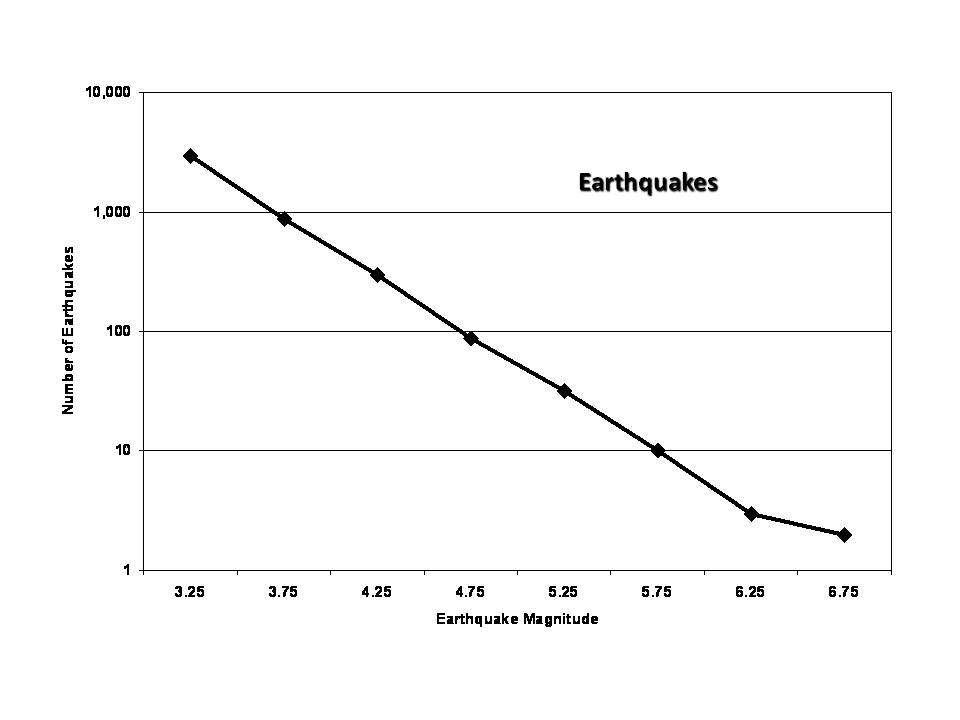
For the years 2007 and 2008, the probability was inversely proportional to magnitude of the day to day change to the 2.1 power with a correlation of 0.94 and 0.98.
What this, in a qualitative sense indicates, is that the market is complex, and therefore day to day change is unpredictable. It also indicates that while the changes in 2008 are terrifying, they fall on the same probability curve as those previous years sampled. It implies that the market is not in equilibrium and that cause and effect are not related. It does not imply anything about long term change.
* Note: To compare 1990 to the other years, the 1990 data were normalized to this time period.
Subscribe to:
Posts (Atom)