
Search Twitter and see the results classified by sentiment. Popular use cases include researching products, seeing what people are saying about your company, and discovering which products you should get.
http://twittersentiment.appspot.com
Monday, May 18, 2009


Thursday, May 14, 2009
The Information Revolution
This video explores the changes in the way we find, store, create, critique, and share information. This video was created as a conversation starter, and works especially well when brainstorming with people about the near future and the skills needed in order to harness, evaluate, and create information effectively.
Monday, May 11, 2009
The Future of the Classroom
From CenTexWFS.
This is a follow-up to our monthly meeting on April 21, 2009. After the slides there are embedded videos mentioned in the presentation and an audio recording of the seminar and discussion. The speakers were:
Archana Ramachandran
Archana Ramachandran spoke on a SXSW Interactive panel regarding the use of technology in the classroom and is part of an the 8-member student team called Longhorn Confidential. She blogs about student lives at UT to give potential students, classmates, and alumni an inside perspective.
She also co-launched @UTweet, a Twitter account designed to educate UT Austin students about Twitter. It has since developed into a blog about social media as a whole and the UT Austin life. In September 2008, UTweet joined forces with Yoono.com to create Social Media Camp.Us, a nationwide university blog about social media.
Follow Archana on Twitter.
Kert Kee
Kerk Kee is a doctoral candidate in the Department of Communication Studies at UT Austin, specializing in organizational communication and communication technology. His research interests include technology (dis)adoption, distributed collaborations, and virtual organizations in educational institutions and scientific communities. For his research projects, he studies Blackboard, Facebook, Second Life, and the National Science Foundation’s cyberinfrastructure (next generation Internet) development.
As an assistant instructor at UT Austin, he teaches team-based communication, organizational communication, and professional communication skills. He is the recipient of the 2008 DIIA (Division of Instructional Innovations and Assessment) Graduate Student Instructor Award and the 2007-2008 Outstanding PhD Student Award in his home department. In Spring 2008, he ran the biggest Second Life class at UT with 57 students. In Fall 2008, The Austin American Statesman interviewed him about his use of Facebook with his students. Currently, he serves as one of the judges for the Innovative Instructional Technology Awards Program, an instructional technology competition sponsored by the UT Office of Provost and DIIA.
Join Kerk on LinkedIn
Listen to an audio recording of the seminar and discussion. (mp3, 205 MB, 90 min)
This is a follow-up to our monthly meeting on April 21, 2009. After the slides there are embedded videos mentioned in the presentation and an audio recording of the seminar and discussion. The speakers were:
Archana Ramachandran
Archana Ramachandran spoke on a SXSW Interactive panel regarding the use of technology in the classroom and is part of an the 8-member student team called Longhorn Confidential. She blogs about student lives at UT to give potential students, classmates, and alumni an inside perspective.
She also co-launched @UTweet, a Twitter account designed to educate UT Austin students about Twitter. It has since developed into a blog about social media as a whole and the UT Austin life. In September 2008, UTweet joined forces with Yoono.com to create Social Media Camp.Us, a nationwide university blog about social media.
Follow Archana on Twitter.
Kert Kee
Kerk Kee is a doctoral candidate in the Department of Communication Studies at UT Austin, specializing in organizational communication and communication technology. His research interests include technology (dis)adoption, distributed collaborations, and virtual organizations in educational institutions and scientific communities. For his research projects, he studies Blackboard, Facebook, Second Life, and the National Science Foundation’s cyberinfrastructure (next generation Internet) development.
As an assistant instructor at UT Austin, he teaches team-based communication, organizational communication, and professional communication skills. He is the recipient of the 2008 DIIA (Division of Instructional Innovations and Assessment) Graduate Student Instructor Award and the 2007-2008 Outstanding PhD Student Award in his home department. In Spring 2008, he ran the biggest Second Life class at UT with 57 students. In Fall 2008, The Austin American Statesman interviewed him about his use of Facebook with his students. Currently, he serves as one of the judges for the Innovative Instructional Technology Awards Program, an instructional technology competition sponsored by the UT Office of Provost and DIIA.
Join Kerk on LinkedIn
Classroom of Tomorrow
View more presentations from Paul Schumann.
Listen to an audio recording of the seminar and discussion. (mp3, 205 MB, 90 min)
Sunday, May 10, 2009
A Moore's Law for Energy?
The Foresight Institute
Earlier this week I was at the premiere of Transcendent Man, a biographical overview of Ray Kurzweil’s views on the coming Singularity. Kurzweil’s main argument is that the power of the exponential in technology is major, systemic, and underappreciated.
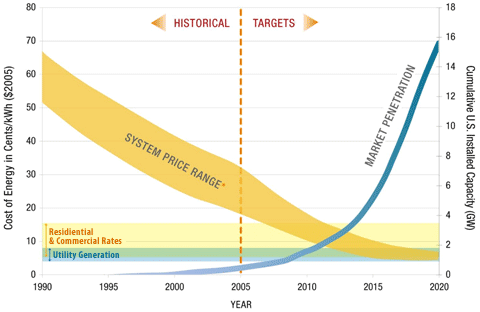
The specific item of interest in this post is Kurzweil’s claim, repeated in the movie, that solar energy is on a Moore’s Law-like curve with a power/$ doubling time of two years:
The crossover of the tipping point where solar energy will be less expensive than fossil fuels in almost every situation is within five years.
This DOE graph says basically the same thing:
More
Earlier this week I was at the premiere of Transcendent Man, a biographical overview of Ray Kurzweil’s views on the coming Singularity. Kurzweil’s main argument is that the power of the exponential in technology is major, systemic, and underappreciated.
The specific item of interest in this post is Kurzweil’s claim, repeated in the movie, that solar energy is on a Moore’s Law-like curve with a power/$ doubling time of two years:
The crossover of the tipping point where solar energy will be less expensive than fossil fuels in almost every situation is within five years.
This DOE graph says basically the same thing:
More
The Second Law of Thermodynamics, Entrophy and Chaos
The Second Law of Thermodynamics can be very simply stated like this: "Energy spontaneously tends to flow from being concentrated in one place to becoming diffused and spread out". It was first formulated to explain how a steam engine worked, it can explain why a cup of tea goes cold if you don't drink it and how a pan of water can be heated to boil an egg.
But its application has been found to be rather grander than this. The Second Law is now used to explain the big bang, the expansion of the cosmos and even suggests our inexorable passage through time towards the 'heat death' of the universe. It's been called the most fundamental law in all of science, and CP Snow in his Two Cultures wrote: "Not knowing the Second Law of Thermodynamics is like never having read a work of Shakespeare".
What is the Second Law? What are its implications for time and energy in the universe, and does it tend to be refuted by the existence of life and the theory of evolution?
More Including a 43 min podcast.
Wednesday, May 6, 2009
Chaos and Godel, Escher, Bach
Chaos: The Making of a Science and Godel, Escher, Back: An Eternal Golden Braid are two additional references for complexity science. I read them in 1987and 1979 respectively when they were published originally.
Chaos is a good overview of the science of chaos and has good explanations of the fundamentals. It is particularly good at describing fractals and their importance, as well as strange attractors.
A twentieth-anniversary edition of the million-copy-plus bestseller has recently been published (2008) “This edition of James Gleick’s groundbreaking bestseller introduces to a whole new readership the story of one of the most significant waves of scientific knowledge in our time. By focusing on the key figures whose genius converged to chart an innovative direction for science, Gleick makes the story of chaos theory not only fascinating but also accessible, and opens our eyes to a surprising new view of the universe.”
Godel, Escher, Bach subtitled “A metaphorical fugue on minds and machines in the spirit of Lewis Carroll” won the Pulitzer Prize and is a book that influenced my thinking. While the book subject is much broader than chaos, complexity and emergence, it does introduce the topic. The chapter entitled “Ant Fugue” discusses the workings of an ant colony and how behavior emerges from the collective that exceeds the intelligence of any individual ant.
Amazon’s review of the 1999 edition states: “Twenty years after it topped the bestseller charts, Douglas R. Hofstadter's Gödel, Escher, Bach: An Eternal Golden Braid is still something of a marvel. Besides being a profound and entertaining meditation on human thought and creativity, this book looks at the surprising points of contact between the music of Bach, the artwork of Escher, and the mathematics of Gödel. It also looks at the prospects for computers and artificial intelligence (AI) for mimicking human thought. For the general reader and the computer techie alike, this book still sets a standard for thinking about the future of computers and their relation to the way we think.
Hofstadter's great achievement in Gödel, Escher, Bach was making abstruse mathematical topics (like undecidability, recursion, and 'strange loops') accessible and remarkably entertaining. Borrowing a page from Lewis Carroll (who might well have been a fan of this book), each chapter presents dialogue between the Tortoise and Achilles, as well as other characters who dramatize concepts discussed later in more detail. Allusions to Bach's music (centering on his Musical Offering) and Escher's continually paradoxical artwork are plentiful here. This more approachable material lets the author delve into serious number theory (concentrating on the ramifications of Gödel's Theorem of Incompleteness) while stopping along the way to ponder the work of a host of other mathematicians, artists, and thinkers.
Topics Covered: J.S. Bach, M.C. Escher, Kurt Gödel: biographical information and work, artificial intelligence (AI) history and theories, strange loops and tangled hierarchies, formal and informal systems, number theory, form in mathematics, figure and ground, consistency, completeness, Euclidean and non-Euclidean geometry, recursive structures, theories of meaning, propositional calculus, typographical number theory, Zen and mathematics, levels of description and computers; theory of mind: neurons, minds and thoughts; undecidability; self-reference and self-representation; Turing test for machine intelligence.”
Chaos: Making a New Science
James Gleick, Penguin Books, 1988, 352 p
Godel, Escher, Bach: An Eternal Golden Braid
Douglas Hofstadter, Basic Books, 1979, 777 p
Subscribe to:
Posts (Atom)